Aging as the Cost of Permanent War
Aging, as most people experience it today, is not just a slow, graceful decline. It is the visible fallout of a lifelong, mostly invisible war between the immune system and the germs that live on a few vulnerable surfaces: the mouth, nose, throat, and upper airway. Excessive aging is driven by constant immune system activity; you are only as healthy - and as “young” - as your immune system, and your immune system is only healthy when it is not constantly switched on.
The system was designed as an emergency response, not a full‑time job. Decades of chronic, low‑grade infections force it into permanent overdrive. Eventually, it burns out, and when it fails, people age quickly and die early after a fast, ugly decline. This chapter starts from that claim and asks: what, exactly, is commanding the system to live in war mode?
Immune Systems Are Obedient, Not Broken
Most people assume that chronic inflammation in aging reflects a defective or self‑destructive immune system. The picture in many clinics is of an immune system that “overreacts” or “attacks the body” for no clear reason, to be suppressed with steroids, NSAIDs, statins, and biologics.
Seen through the lens of the mouth and upper airway, a different story emerges. The immune system is not misbehaving when it reacts to chronic mouth and airway infections; it is doing exactly what it was designed to do—just for far too long. The internal cost of that constant, unresolved activity is what gerontologists now call inflammaging: a state of relentless, low‑grade inflammation that quietly drives heart disease, diabetes, cognitive decline, muscle loss, frailty, and loss of independence. Inflammaging often starts in your mouth.
Two Pictures of Aging: Medical and Mucosal
To understand why this has been missed, it helps to see the story from two angles.
In the first picture, aging is a kind of internal biochemical fate. Chronic inflammation is treated as idiopathic (of unknown origin) and inevitable: something that just happens as we get older and must be managed with pills, surgeries, and lifestyle lectures. The immune system appears mainly as a problem to be suppressed, and the mucosal surfaces of the mouth, nose, and upper airway—the front lines where most of the immune activation is actually triggered—are almost nowhere to be found.
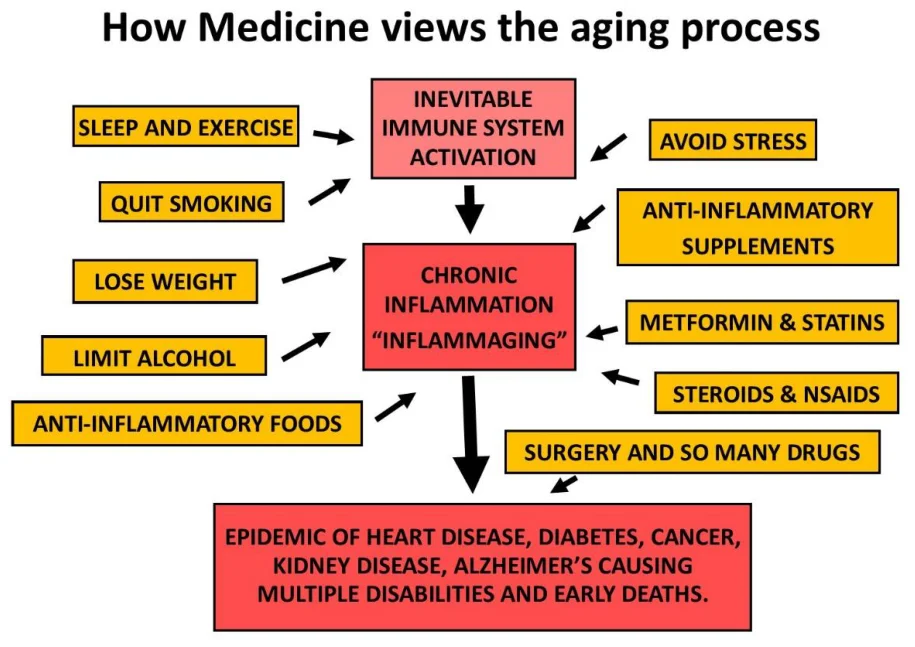
In the second picture, aging is viewed from inside an older mouth and upper airway. The mouth, sinuses, and throat are chronically colonized; gum disease smolders for decades; dentures and appliances grow bacterial carpets; throats, tonsils, and nasal passages harbor persistent pathogens and allergens. Each of these sites constantly emits danger signals, keeping the immune machinery in a low‑grade state of war and turning inflammaging from an abstract concept into the predictable outcome of leaving these borders dirty.
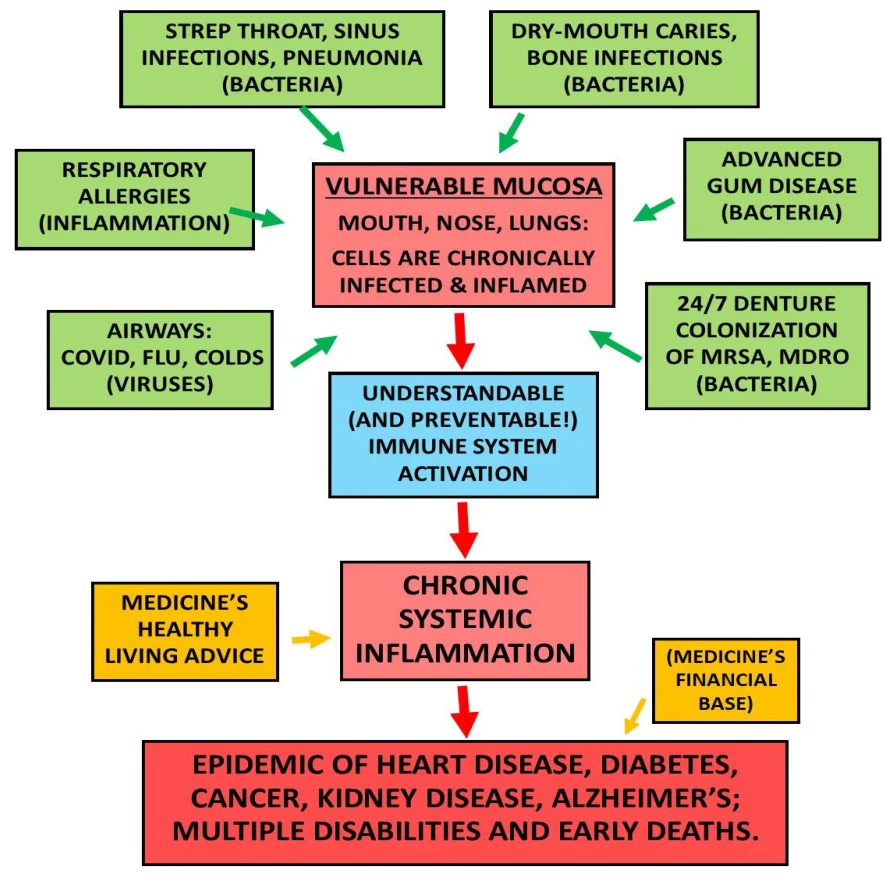
Once the mucosal picture is adopted, chronic inflammation stops looking like an inexplicable curse of time and starts looking like obedience to a continuous stream of local alarms.
Focal Infections and the Mouth–Body Connection
More than a century ago, W. D. Miller, often called the Father of Oral Microbiology, saw the outline of this problem. He argued that the mouth is not an isolated plumbing problem but a focus of infection for the entire person. A focal infection is a localized, sometimes silent infection that causes disease elsewhere in the host, and in Miller’s view the mouth was a gathering place and incubator of pathogenic germs with body‑wide consequences.
He showed that dental decay is caused by oral bacteria fermenting carbohydrates into acid and gave dentistry its first solid biochemical justification for brushing and mechanically removing plaque. But he also proposed that chronic oral infections could “bleed” toxins and bacteria into the bloodstream and quietly poison distant organs, an idea that became known as the focal infection theory.
Modern research has largely confirmed Miller’s intuition. Chronic gum disease and other oral infections can keep the immune system in continuous action, driving silent, body‑wide inflammaging. Decades of low‑grade periodontal disease, sinus disease, and other focal infections create a smoldering inflammatory fire that weakens immunity, accelerates degeneration, and sets the stage for the chronic diseases of aging.
Miller’s great tragedy was that he never found a safe, practical oral antiseptic that could quiet these infections at their source without harming the host. He spent years searching, and then dentistry and medicine largely stopped looking. Mechanical hygiene survived; the deeper idea—that cleaning up focal infections might change the course of systemic disease—did not.
From Focal Infection to Focal Homeostasis (Maintained Health)
The concept of focal infection can be extended into something more hopeful. If a chronically diseased mouth can act as a focal source of inflammation and damage, then a well‑managed mouth can act as a focal source of homeostasis. Instead of emitting a constant stream of PAMPs, toxins, and danger signals, a clean, low‑load mucosa can send quieter messages to the immune system, allowing it to spend more time in repair and regeneration.
Seen this way, the mouth–nose–throat corridor is not just a problem to be patched; it is the main control lever for how often the immune system is forced into crisis. A small shift in how clean these surfaces are, in a biochemical sense, can translate into large differences in how often the entire body is dragged into war mode.
Okinawan Superagers – What Low Inflammation Looks Like in Real Life
On the Japanese island of Okinawa, a disproportionate number of people reach their 90s and 100s with preserved function, clear minds, and relatively low rates of cardiovascular disease and diabetes. Their lives embody the two themes of this book: excellent hygiene at the borders and a body that spends most of its time in immune peacetime, not war.
Several features stand out:
- Meticulous daily hygiene, including the mouth. Older Okinawans brush frequently, keep more of their natural teeth than Western peers, and routinely drink green and jasmine teas with meals. Green tea catechins have direct antimicrobial and anti‑inflammatory effects on oral bacteria and periodontal tissues, acting as a mild oral antiseptic every morning and evening.
- A plant‑forward, anti‑inflammatory diet and active lifestyle. Traditional Okinawan diets are low in calories but dense in phytonutrients, with abundant vegetables, tubers, and soy, minimal refined sugar, and modest fish intake, while daily walking, gardening, and social engagement remain common into advanced age.
- Quieter cytokine tone in “successful agers.” Studies of centenarians, their offspring, and carriers of longevity‑linked FOXO3 variants show a characteristic pattern: lower or blunted age‑related rises in pro‑inflammatory cytokines such as IL‑6 and TNF‑α, and relatively preserved or enhanced anti‑inflammatory mediators such as IL‑10 compared with typical older adults. This means their blood does not live in the same chronic, low‑grade inflammatory state seen in most aging populations.
Ref: Willcox, D. Craig, et al. “The Okinawa Centenarian Study: Health and lifestyle factors of a population of centenarians and their offspring.” Gerontology, vol. 43, suppl. 1, 1997, pp. 108– 109. DOI: 10.1159/000213723.
Taken together, these findings offer a proof‑of‑concept: when a population combines good genes with meticulous daily hygiene and sensible habits, the immune system spends less time in full activation mode and more time in repair, surveillance, and regeneration. The rest of this book asks whether the hygiene side of that equation can be generalized for everyone—using a physiologic antiseptic, hypochlorous acid, to bring Miller‑level oral and skin cleanliness into ordinary homes, even where diet and genetics are less ideal.
Why the War on Aging Is a War on Germs at the Oral–Airway Frontier
If aging is, in large part, the price of running the immune engine too hard against preventable mucosal infections, then the war on aging is, at its core, a war on germs where they actually live. Chronic colonization and biofilm in the mouth and upper airway create a steady drizzle of microbial products and damage signals into the bloodstream.
Each local flare—bleeding gums, a recurring sore throat, a sinus infection—triggers the same systemic cascade: cytokines surge, metabolism shifts into emergency mode, and neutrophils manufacture hypochlorous acid and other oxidants to kill germs and neutralize their toxins. In youth, these battles usually end cleanly and the system stands down; with age and chronic infection, the loop from activation to resolution fails, and the war setting becomes the new normal.
Over years and decades, the microscopic self‑injury from each “saved” infection accumulates. Blood vessels become inflamed, tissues stiffen, metabolism derails, and the immune system itself becomes exhausted and dysregulated. When a final systemic infection arrives—pneumonia, COVID, influenza, a bad urinary tract infection, or sepsis—an immune system already worn down by years of overuse may not be able to mount an adequate defense. What should have been a recoverable illness becomes the beginning of a steep, irreversible decline in strength, cognition, mobility, and independence.
The Missing Antiseptic and the Second Dentist’s Turn In this story, Miller is not the only dentist. A second dentist, working more than a century later with older adults, watched a different but related tragedy unfold. Patients would come in after a serious illness—a bad pneumonia, a COVID hospitalization, a bout of sepsis—and from that point their lives tilted downhill. Their energy never fully returned; their walking slowed; falls became more common; their thinking dulled; their mouths collapsed along with the rest of them. By the time they reached the dental chair, fixing teeth felt like cosmetic work on a sinking ship.
Recognizing his own future in their stories, this dentist went looking for answers not in new gadgets or cosmetic procedures, but in immunology, biochemistry, and the body’s own germ‑killing chemistry. That search led to an overlooked fact: the innate immune system already uses chlorine in a sophisticated way, generating hypochlorous acid as a primary weapon against microbial proteins and toxins.
Using modern tools and research that Miller never had, it became possible to do what he could not: design a simple, safe, kitchen‑made chlorine solution that mimics the body’s own hypochlorous acid and can be used daily on the very mucosal surfaces where most infections begin. In other words, to find the missing antiseptic that allows ordinary people to take personal control over the germs that drive inflammaging.
This chapter does not yet explain how that solution is made or exactly how hypochlorous acid works inside neutrophils. Those details matter, and they will come next. For now, the point is simpler: aging and illness are more preventable than they appear if the immune system’s daily workload at the mouth–nose–throat frontier can be dramatically reduced.
Who This Book Is For—and How the Science Story Begins
This book speaks to two groups at once. For clinicians and scientifically inclined readers, it offers a deep dive into the chlorine biochemistry of innate immunity and the ten‑step immune cascade that runs from first danger signals to stand‑down. For educated lay readers, it offers enough immunology and chemistry to understand why the mucosal frontier is the main battlefield of aging and how a straightforward daily routine can lighten the immune system’s workload.
Aging is now reframed as the cost of chronic immune war commanded by focal infections in the mouth and upper airway. The next step is to open the hood on that war machine. Chapter 2 walks the immune system step by step—from the first pathogen surge and damage signals at the mucosal border, through cytokine mobilization and the decisive hypochlorous acid burst, to the resolution phase that is supposed to restore peace. Only after our immune machinery is clear will the book fully turn to the practical question that matters most:
How can a simple daily routine at the bathroom sink protect a tired immune system from ever having to fight its last, losing battle?