The challenge, which eluded Miller, was finding a concentration of HOCl that behaves like the body’s own chlorine: strong enough to collapse virulence proteins, gentle enough to leave host tissues and microbiome architecture intact. Modern work, especially that of Dr. Ono in Japan, finally identified such a window.
In 1997, infection-control specialist William A. Rutala, PhD, published a landmark review for Clorox titled “Uses of inorganic hypochlorite (bleach) in health-care facilities.” In his abstract, he lists almost every property one could want in a disinfectant—broad antimicrobial activity, rapid kill, reasonable persistence, ease of use, solubility, stability, relative nontoxicity at use concentrations, no poisonous residues, no staining, and low cost—and then adds the crucial line: “The active species is undissociated hypochlorous acid (HOCl).” On paper, chlorine already looked like the blueprint for an ideal antiseptic, not just a surface disinfectant.
Rutala’s compilation, however, is a confusing patchwork of experiments. Eight variables shift from study to study: organism type, susceptibility to chlorine, total chlorine concentration, contact time, temperature, organic load, log-kill achieved, and pH, which controls the HOCl versus hypochlorite ratio. At best, one can say that some concentration of HOCl, at some pH, for some duration, will kill some microbes. For bedside clinicians and patients, this is nearly useless. Almost all tests were done at room temperature, not at 37 ºC where skin and mucosa actually live, and the focus remained on disinfection of objects rather than safe antisepsis of living tissue.
Rutala is explicit about this boundary. On the one hand, he writes: “Chlorine in the form of hypochlorous acid, even in minute quantities, exhibits rapid microbicidal activity.” On the other, he dismisses chlorine for modern wound care: “Although hypochlorites were commonly used as wound antiseptics in the early part of the century, they are rarely used today because of irritation and, when used at high concentrations, toxicity.”
In his later CDC Guideline for Disinfection and Sterilization in Healthcare Facilities, updated in 2024, he codifies the split: “Antiseptics are used only on the skin and not for surface disinfection, and disinfectants are not used for skin antisepsis because they can injure skin and other tissues.” Bleach—concentrated hypochlorite buffered with excess hydroxide—fits that warning. Its irritation and corrosion come largely from the hidden lye content, not from HOCl itself.
If bleach is too harsh, the obvious question is whether a very weak, HOCl‑rich solution could behave like the body’s own chlorine: powerful against microbes, gentle to tissues.
The ideal antiseptic would be safe, cheap, simple to use, and able to kill essentially all relevant pathogens in seconds, not minutes. This is exactly what W. D. Miller was searching for as his suitable oral antiseptic and never found.
For clarity, such a test must fix key variables—one low total chlorine concentration, physiologic temperature, high microbial load, minimal extraneous organic debris, and a demand for complete kill—while varying only what matters most: organism type and solution pH.
In 2012, a Japanese team led by Tomoko Ono did almost exactly this, though they framed it as a disinfectant study. They prepared weak “acidic” hypochlorous solutions containing 50 ppm total chlorine at pH 5.0, 6.0, 7.0, and 8.0 by mixing sodium hypochlorite and hydrochloric acid in water, then challenged them in vitro with a large panel of microbes. Their test set included 47 bacterial strains (many multidrug resistant, several spore-formers), two fungi, and a representative virus, at inocula around 10⁷ CFU/ml—roughly the microbial density of an infected site.
The results read like a checklist for an ideal antiseptic. First, 50 ppm total chlorine—a very dilute solution—showed “excellent microbicidal effect” and rendered all tested bacteria, fungi, and the virus culture‑negative within 15–60 seconds; only spores required several minutes.
Second, performance tracked pH, not total chlorine: solutions at pH 5–6, where 95–97 percent of chlorine exists as HOCl, were the fastest and most reliable killers. At pH 8, with only about 24 percent HOCl and the rest as hypochlorite ion, killing slowed dramatically, especially for spores.
Third, kinetic analysis and follow‑up showed that hypochlorite ion itself contributed little direct germicidal action; HOCl was the active species. Ono concluded that “the microbicidal effect did not depend on the available chlorine concentration but on the HOCl concentration,” confirming earlier work and Rutala’s own statement about undissociated HOCl.
This single experiment quietly answers the practical questions Rutala’s review left hanging.
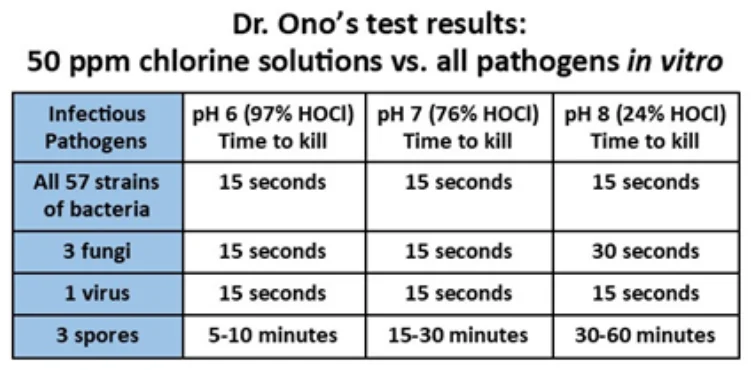
A 50 ppm HOCl solution, adjusted to slightly acidic pH around 6, can kill a broad spectrum of bacteria—including drug-resistant ESKAPE strains—plus fungi and at least one tested virus within 15 seconds at room temperature, starting from high microbial loads.
At body temperature, and especially in inflamed tissue, the same chemistry will act even faster, because reaction rates increase with heat. Ono also showed that spores, while harder to kill, still succumb within minutes at high HOCl fractions, and that raising hypochlorite at the expense of HOCl only slows the process.
Put simply, Ono rediscovered the concentration and pH window where chlorine behaves like an ideal personal antiseptic: very dilute, predominantly in the HOCl form, yet still “rapidly microbicidal” against almost everything that threatens skin and mucosa. The next step is obvious: translate that recipe—a 50–100 ppm HOCl solution at about pH 6—into a reproducible, mouth-safe formula that patients can mix and use at home.
A quick Googe Scholar search of “hypochlorous, antiseptic, COVID” reveals this research paper by M. Gessa Sorroche, Hypochlorous acid as an antiseptic in the care of patients with suspected COVID-19 infection. Arch Soc Esp Ophthalmol. 2022;97:77–80
Sorroche’s conclusions: “The 0.01% (100 ppm) hypochlorous acid could act as an effective antiseptic against SARS CoV-2, exerting a barrier on the mucosa to prevent COVID-19 infection. It can be used on the eyes, nose and mouth. Its recommendation could even be considered in the general population to reduce the viral load and/or prevent transmission of the infection.”
That, my friends, is our ideal mucosal antiseptic:
pH controls how much chlorine will be HOCl hypochlorous or OCl hypochlorite
Dr. Rutala writes about pH and HOCl’s maximum effectiveness at pH 6: “The active species is undissociated hypochlorous acid (HOCl), not chlorine. The dissociation of hypochlorous acid to the less microbicidal form (hypochlorite ion) is dependent on pH.
As the pH increases, more hypochlorite ion is formed and the microbicidal activity decreases. Disinfection by chlorination is optimal at around pH 6 because the concentration of HOCl is optimal and its dissociation is minimal.”
Chlorine in solution exists in one of three forms determined by solution acidity or alkalinity. In very alkaline solutions above pH 10, chlorine exists exclusively as hypochlorite OCl-. .In very acidic solutions below pH 3, chlorine exists increasingly as gaseous chlorine, Cl2.
The three biologically relevant pHs 6, 7, and 8, were studied by Dr. Ono and he confirmed that HOCl concentration is maximized in the slightly acidic solutions, pH 5-6. This science, at least, is settled.
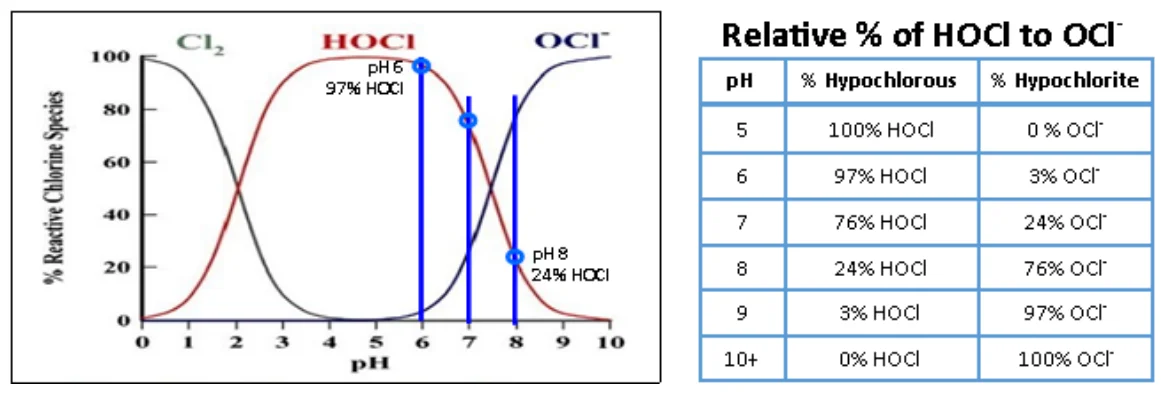
Dr. Ono showed only HOCl kills germs. Hypochlorite form is an inert precursor.
To survive bad conditions some bacteria or fungi turn into hard layered knots or spores that can wake up when conditions for growth are better. That’s not a problem for our quest to protect mucosa where it’s a microbial Garden of Eden. Spores are not common nor much needed here.
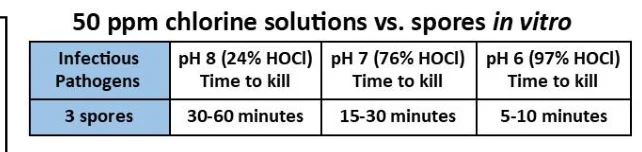
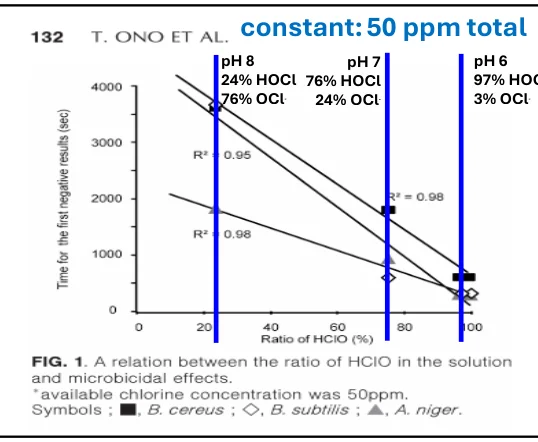
But Spores are very hard to kill as they can withstand UV, heat, dry, antibiotics, and germicides. Ono killed the spores in ten minutes with his 97% HOCl solution. Not 15 seconds, but not bad. The fact that 24% HOCl needed six times the time to disable spores proves the high hypochlorite content is inactive.
Text in this figure
pH 8 24% HOCl 76% OCl- constant: 50 ppm total pH 7 76% HOCl 24% OCl- pH 6 97% HOC 3% OCl-
Dr. Ono’s experiments with killing spores shows total chlorine concentration was meaningless without considering pH. Only HOCl can chlorinate a protein.
Ono: “This result indicates that microbicidal effect of hypochlorous solutions do not depend on the (total) available chlorine concentration but on the HOCl concentration, and it agrees with the results of previous research.”
Ono’s 50-100 ppm hypochlorous acid at pH 6 is Miller’s missing ideal antiseptic