Cystic fibrosis is the prototype HOCl-desert disease: a genetic failure of chloride transport into neutrophil phagolysosomes that strands myeloperoxidase without adequate substrate and leaves the airways without full chlorine oxidant defense.
In the mouth, on the tongue, on dentures, in smokers' throats, and across the accessible upper airway, the practical logic of this book has been simple: if a mucosal surface is chronically loaded with microbes, mucus, biofilm, and inflammatory debris, then gentle chlorine-assisted hygiene can reduce that load and lower the immune system's daily workload.
The question in cystic fibrosis is whether the same logic stops at the glottis—or whether the lower airway, where the defect is deepest, is actually where chlorine replacement makes the most conceptual sense.
This chapter is not a treatment manual. It is a treatment proposal and a research challenge. Biochemistry suggests that cystic fibrosis care can be supplemented and maybe even replaced by home-level chemistry. The claim is if CF lungs are defined by too little water at the airway surface and too little effective HOCl chemistry where neutrophils need it most, then supplying chlorine-and-water chemistry to the mucus phase deserves careful study as an adjunct to modern CF care.
CF immune system works until last step: No germ- killing chlorine. CF WBCs shoot blanks! In a healthy person, when a neutrophil engulfs a bacterium, it creates a tiny execution chamber—the phagolysosome—and rapidly fills it with reactive oxygen species. Myeloperoxidase uses hydrogen peroxide and chloride to generate hypochlorous acid, the main chlorine weapon of innate immunity.
In cystic fibrosis, the CFTR channel protein that normally moves chloride into that compartment is defective, so the neutrophil's phagosomal HOCl burst is blunted. The immune cell can still arrive, still engulf, and still launch oxidant chemistry, but the decisive chlorination step is weakened.
That single defect has enormous consequences. Engulfed bacteria are more likely to survive long enough to leak pieces of themselves back into tissue. Neutrophils remain recruited, elastase and extracellular oxidants spill into mucus, epithelial cells are repeatedly injured, and the airway never gets to stand down.
Thick secretions, extracellular DNA, abnormal mucus rheology, and biofilm architecture then lock the system into a chronic state of infection plus inflammation. In other words, the chlorine factory is not absent, but it is born disadvantaged and forced to fight under bad conditions from the first day of life.
Nobody Thought To First Replace What Is Missing?
Medicine often understands deficiency most clearly when the replacement is obvious. Water is given when tissues are dry. Calories are given when a body is starving. Blood is given when blood has been lost. Yet cystic fibrosis, a disease defined by dehydrated airway surfaces and impaired chloride-dependent antimicrobial chemistry, is rarely framed in those same replacement terms.
This chapter argues that the first missing materials in cystic fibrosis are not mysterious. They are water at the airway surface and effective chlorine chemistry in the mucus-infection zone. That does not mean the problem is simple. It means the replacement logic is simple. The lungs are too dry, too colonized, too biofilm-protected, and too chronically inflamed.
If current care can partly restore hydration and partly reduce microbial burden, then it is reasonable to ask whether carefully designed external HOCl or N-chlorotaurine could supplement the missing chemistry at the one place where the defect matters most: inside infected airway secretions.
Why CF Mucus Favors the Microscopic Enemy
The organisms that dominate cystic fibrosis airways are not random contaminants. They are specialists in persistence. Staphylococcus aureus, including MRSA strains, and Pseudomonas aeruginosa are classic long-term colonizers, and fungi such as Aspergillus fumigatus, Aspergillus terreus, Scedosporium species, Lomentospora prolificans, Exophiala dermatitidis, and others can also contribute to clinical decline. In cystic fibrosis they do not merely drift through the lung. They adapt to the mucus, exploit its nutrients, shelter in biofilms, and survive repeated antimicrobial attack.
This matters because the CF airway is not just infected. It is converted into a protected ecology of chronic colonization. Biofilm and viscous mucus make it difficult for antibiotics, antibodies, oxidants, and phagocytes to reach pathogens cleanly. The result is a tragic mismatch: too little HOCl where it should be concentrated inside phagosomes and at the organism surface, and too much inflammatory collateral damage in the surrounding tissue and mucus.
Gruber’s CF sputum study: proof of CF mucosal hygiene concept
Gruber et al. showed that N‑chlorotaurine does not get neutralized by CF‑like sputum. In artificial sputum medium designed to mimic cystic fibrosis mucus, 1% NCT rapidly killed the main CF bacterial and fungal organisms, reducing them to the detection limit within about 10–15 minutes, while even 0.1–0.3% retained meaningful log‑reductions.
See: Gruber M, Moser I, Nagl M, Lackner M. Bactericidal and fungicidal activity of N‑chlorotaurine is enhanced in cystic fibrosis sputum medium. Antimicrob Agents Chemother. 2017;61(5):e02527‑16.
The key point is that NCT worked better in CF sputum medium than in plain buffer, especially against fungi. The likely reason is trans-halogenation: in the protein‑rich mucus environment, NCT forms secondary chloramines such as monochloramine that penetrate pathogens more effectively. For this chapter, that is the needed proof of concept: CF mucus is not just a barrier to chlorine chemistry; it may be a medium in which NCT becomes especially useful.
The same way daily chlorine hygiene helps control biofilm in the oral cavity, these findings support the idea that daily NCT‑based hygiene of the CF mucus layer could help lower chronic airway biofilm burden and deserves formal clinical study.
Proof of principle: NCT inhalation vs fungal infection in animals
The second question is tolerability. It is one thing to kill pathogens in sputum medium and another to deliver chlorine chemistry into living lungs. Repeated inhalation of 1% N‑chlorotaurine has been reported as well tolerated in pig and mouse studies, with preserved lung function, intact surfactant behavior, and no major histologic injury. A placebo‑controlled phase I study in healthy volunteers found that once‑daily inhalation of 1% NCT for five days was similarly well tolerated compared with saline.
A newer in vivo proof‑of‑concept strengthens the case further: in a mouse model of Aspergillus fumigatus pneumonia in immunocompromised lungs, aerosolized NCT substantially improved survival, sharply lowered fungal burden, and reduced opportunistic bacterial co‑infection, with 1% emerging as a strong efficacy–tolerability balance. This was not a CF model, but it showed in living inflamed lungs that exogenous chlorine chemistry can move beyond a dish and alter the outcome of lethal infection.
See: Speth C, Rambach G, Lass-Flörl C, et al. Efficacy of inhaled N-chlorotaurine in a mouse model of fungal pneumonia. J Innate Immun. 2022;14(5):338-352.
Proof of principle in humans: NCT inhalation successfully treated cystic fibrosis patients
On that backdrop, an early human CF series by Schwarz and colleagues makes the replacement logic concrete rather than hypothetical. Ten cystic fibrosis patients inhaled 5 mL of 1% N‑chlorotaurine via nebulizer twice daily for periods ranging from several weeks to multiple years, targeting multi-resistant bacteria, fungi, and respiratory viruses—including Pseudomonas aeruginosa, MRSA, Achromobacter xylosoxidans, Scedosporium apiospermum, and SARS‑CoV‑2.
In this small, uncontrolled group, inhaled NCT was well tolerated and was associated with improved sputum production and color, fewer pulmonary exacerbations, and reduced need for intravenous antibiotics. Chlorine-assisted hygiene helps chlorine-deficient CF lungs.
See: Schwarz C, Lackner M, Eschenhagen P, Nagl M, INN breath study group. “N- chlorotaurine is a very promising antiseptic treatment option for multi-resistant bacteria, fungi and for viruses including SARS CoV 2 in cystic fibrosis patients.” Conference abstract, Charité CF Center Berlin and University of Innsbruck, Institute of Hygiene and Medical Microbiology. Journal of Cystic Fibrosis 20S1 (2021) S29–S38
For this chapter, the importance of that report is not that it proves NCT as definitive CF therapy, but that real CF lungs—already colonized, inflamed, and fragile—could receive bio‑identical downstream chlorine oxidant twice daily over months to years with encouraging safety and signal in exactly the microbial and inflammatory terrain where CF patients struggle most.
NCT, CF, and the cytokine bridge to Inflammaging
The antimicrobial case alone would be enough to justify attention, but it is not the whole story. One of the reasons Part 5 exists is to follow chlorine biochemistry beyond germ killing and into the logic of inflammatory resolution.
The Speth line of work and related taurine chloramine studies suggest that NCT may do more than reduce microbial burden; it may also reduce inflammatory signaling by down‑regulating NF‑κB‑linked cytokine pathways and softening the systemic and local costs of prolonged immune activation. That possibility matters especially in cystic fibrosis. CF lungs are not harmed only by microbes. They are harmed by years of neutrophil over‑recruitment, protease spill, cytokine excess, mucus obstruction, and epithelial injury—an accelerated model of unresolved inflammation, tissue remodeling, and premature local senescence.
If NCT can simultaneously reduce microbial load in CF‑like sputum, behave safely in animal lungs and healthy volunteers, and show early clinical benefit in CF patients while softening inflammatory signaling in injured tissues, then it becomes a bridge molecule between this chapter and the next five. It is no longer only an antiseptic. It becomes a candidate resolution‑supporting chemistry in an organ that never gets to finish a battle.
The proposal, narrowly stated: test it, please
The proposal of this chapter should therefore be stated carefully. It is not that cystic fibrosis patients should abandon modulators, antibiotics, airway‑clearance techniques, mucolytics, bronchodilators, or specialist care.
It is not that the home‑use HOCl routines described earlier in this book should simply be extended into the deep lung by analogy. And it is not that inhaled chlorine species are ready for unsupervised use in a disease as complex as CF.
The proposal is that cystic fibrosis makes the chlorine‑replacement question unusually clear. The disease combines dehydrated airway surfaces, persistent biofilm infection, impaired chloride‑dependent phagosomal killing, and relentless cytokine injury. Gruber’s CF sputum work shows that NCT remains strongly active in that mucus environment and may even work better there than in buffer. Animal and early human inhalation studies, capped by the small Schwarz CF series, show that NCT can reach living lungs with encouraging tolerability and early clinical benefit. Together these findings point toward an obvious next step: carefully supervised clinical trials of inhaled medical‑grade chlorine‑and‑water strategies—especially NCT and possibly physiologic HOCl—as adjuncts to standard CF care.
Looking Ahead
Cystic fibrosis is the prototype HOCl-desert disease, but it is not the only way the immune system gets trapped in permanent war. In CF the defect begins with chloride transport and persistent infection. In the chapters that follow, the trap widens. Cytokines become self- sustaining. Sulfur-selective chlorine chemistry helps explain why HOCl can disable virulence without random destruction. N-chlorotaurine emerges as the gentler downstream oxidant that may help lower pathological inflammatory tone. Then the same unresolved-war logic reappears in obesity, metabolic syndrome, and cellular senescence.
CF therefore belongs at the front end of Part 5 for a reason. It is the clearest disease in which the language of chlorine replacement can still be heard without too much abstraction. It lets the reader see, in one organ and one inherited defect, what the rest of this section will argue more broadly: that much chronic disease is the biology of a battle that never gets to end, and that supplying the right chemistry at the right surface may sometimes be the most natural way to help the body remember how to heal.
Looking past CF: What other chlorine factories get broken and how to protect them too
Cystic fibrosis is the prototype HOCl desert disease: a single genetic lesion in CFTR blocks chloride delivery into neutrophil phagolysosomes, stranding intact MPO without substrate and stripping the airways of their main antimicrobial oxidant. Once that mechanism is clear, the same replacement logic can be adapted almost step‑for‑step to any condition that either removes neutrophils, disables their oxidative burst, prevents them from reaching mucosal surfaces, or exhausts them in chronic inflammation.
HOCl‑desert diseases following CF
In chronic granulomatous disease, NADPH oxidase mutations abolish the oxidative burst so no H2O2 is generated and MPO cannot make HOCl, forcing macrophages into granuloma‑building M1 overdrive that still cannot sterilize tissues. Here the CF inhaled protocol simply shifts to topical, mucosal, or even systemic HOCl/NCT, externally supplying oxidant chemistry that bypasses the missing oxidase.
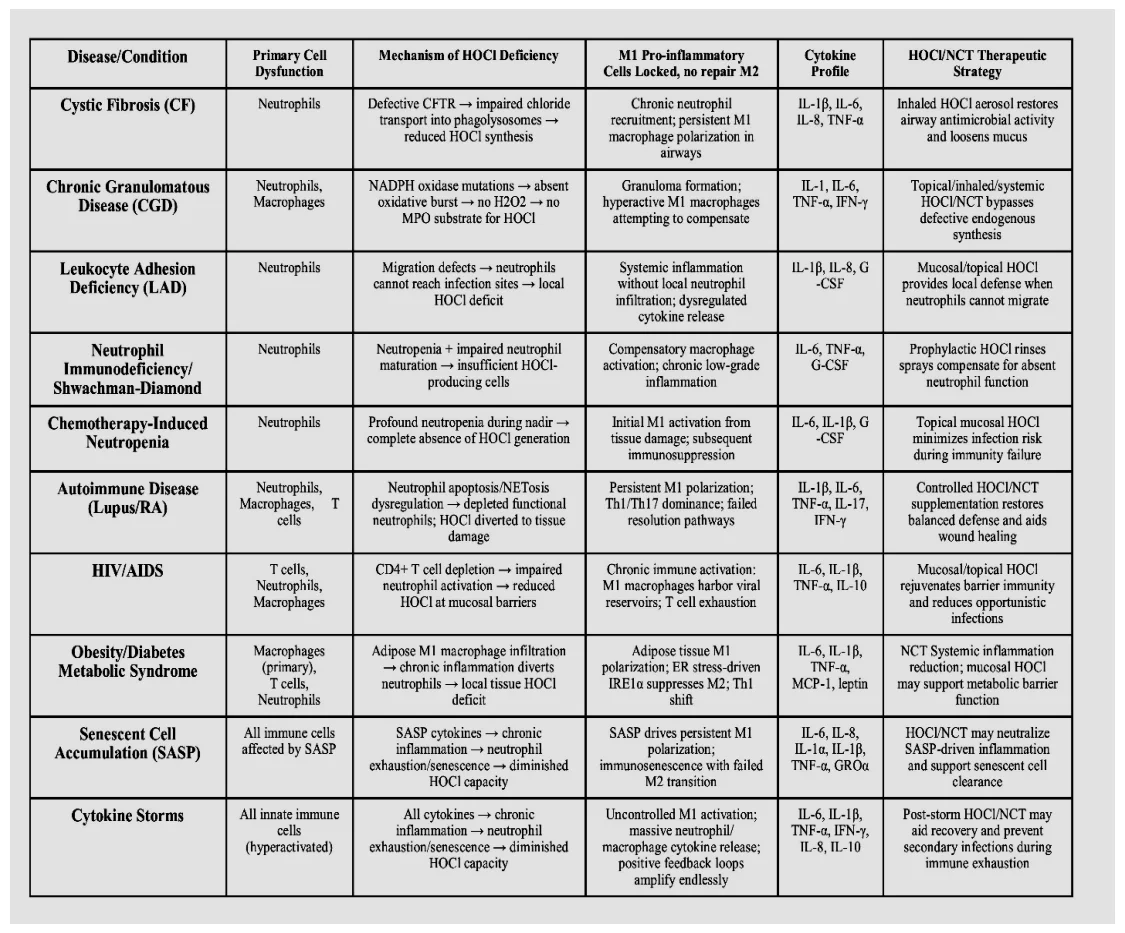
Leukocyte adhesion deficiency does not damage the neutrophil’s chemistry but blocks its migration, so infection sites become local HOCl deserts despite normal circulating cells. In this setting, CF‑style airway dosing becomes targeted mucosal or cutaneous HOCl application at barrier surfaces the neutrophils cannot reliably reach.
In neutrophil immunodeficiencies such as Shwachman–Diamond syndrome and chemotherapy‑induced neutropenia, the problem is simply too few mature neutrophils to sustain HOCl output anywhere in the body. The adaptable CF protocol becomes prophylactic rinses, sprays, and mucosal applications during periods of low counts, providing surrogate barrier disinfection while endogenous production is absent.
Autoimmune diseases like lupus and rheumatoid arthritis deplete functional neutrophils through excessive apoptosis and NETosis while locking macrophages and Th1/Th17 cells in a pro‑inflammatory M1 state that diverts HOCl toward sterile tissue damage instead of barrier defense. Here CF‑style replacement is repurposed as controlled HOCl/NCT supplementation at inflamed mucosa and wounds, aiming to restore front‑line defense and reduce the infectious load that keeps M1 polarization frozen in place.
HIV/AIDS creates a parallel vulnerability to CF at mucosal barriers by depleting CD4 T cells, impairing neutrophil activation, and leaving chronic M1‑polarized macrophage reservoirs that leak IL‑6, IL‑1, TNF‑α, and IL‑10. In these patients, the adaptable CF protocol becomes long‑term mucosal and topical HOCl use to rejuvenate local antimicrobial activity and decrease opportunistic colonization without depending on fully intact neutrophil signaling.
Extending anti-inflammation pushes to metabolic and senescence biology
Beyond these classical neutrophil disorders, obesity/diabetes and senescent cell accumulation extend the same HOCl desert pattern into macrophage‑driven and aging‑driven inflammation, where M1‑polarized adipose or SASP‑primed cells exhaust neutrophils and block M2 repair. At this point the narrative can naturally shift from barrier‑focused HOCl replacement, modeled on CF and its cousins, to N‑chlorotaurine as a gentler, longer‑lived chloramine capable of damping IL‑6/IL‑1/TNF‑α loops in metabolic syndrome, immunosenescence, and post‑storm recovery.