In “The Microorganisms of the Human Mouth” (1890), Miller summarized his exhaustive testing of dozens of antiseptics and laid out the precise specifications for his ideal oral antiseptic: rapid kill of mouth pathogens, deep penetration into food‑impacted foci, and safety for daily home use. This book continues that unfinished work with modern chemistry and immunology.
The first focal infection Miller warned about is not exotic or rare; it is the everyday biofilm that coats teeth, gums, tongue, and every appliance in the mouth. A proper oral antiseptic must prove itself here before anyone trusts it in the nose, throat, or lungs. Biofilm is the prototype problem list for Miller’s ideal antiseptic:
- Dental plaque and periodontal pockets – the most common chronic infections on earth, continuously leaking lipopolysaccharide and other PAMPs into the bloodstream and driving systemic inflammaging.
- Tongue biofilm – the largest microbial reservoir in the mouth, loaded with gram‑negative anaerobes that generate volatile sulfur compounds and reseed cleaned teeth within hours.
- Denture and appliance biofilm – dense communities on acrylic and metal surfaces that act as reinfection reservoirs for gums, palate, and airway.
- ENT biofilms – chronic sinusitis, adenoiditis, and middle ear effusions that behave like subgingival pockets in the head and neck.
- Lung biofilms – cystic fibrosis as the extreme example of an HOCl‑deficient airway, with COPD and bronchiectasis as milder cousins.
- Chronic wound and device biofilms – diabetic ulcers, pressure sores, catheters, and prosthetic joints where the same EPS physics keeps infection alive.
This chapter finishes Miller’s missing work on the first three items in that list—the oral biofilm—using Ono’s ideal HOCl antiseptic as the tool he never had. Once the mouth model is proven, the same chlorine logic can be handed off to pulmonologists, ENT surgeons, wound specialists, and others for their own biofilm battlefields.
Why Mechanical Oral Hygiene Alone Fails
Miller gave dentistry its mechanical foundation: brush and floss to disrupt plaque so bacteria cannot ferment carbohydrates into enamel‑dissolving acids. For a century, mechanical plaque control was expected to prevent both surface caries and deep anaerobic infections. In reality, children still get rampant caries, older adults lose teeth to periodontitis, and deep pockets thrive in medically complex, xerostomic patients.
Dental biofilm is not a smear of germs that wipes off with nylon bristles; it is a three‑dimensional community of bacteria embedded in an extracellular polymeric substance (EPS) matrix with water channels and signaling molecules. A toothbrush scrubs only what it can physically touch and only to a shallow depth; subgingival biofilm, crypt biofilm, and the EPS “glue” persist and begin to re‑establish within 24 hours. The result is predictable: even after excellent brushing, pathogenic thickness and composition are restored by the next day.
Periodontal disease shows how well hidden this infection can be. Gram‑negative anaerobes such as Porphyromonas gingivalis, Tannerella forsythia, Treponema denticola, Fusobacterium nucleatum, and Aggregatibacter actinomycetemcomitans thrive in 5–10 mm gingival pockets that toothbrushes and many irrigators barely reach. Their lipopolysaccharide drives TLR‑mediated cytokine production, creating a persistent PAMP signal that links these “local” pockets directly to systemic inflammaging.
How Biofilm Helps Bacteria and Hurts Us
For microbes, biofilm is a survival machine. The EPS matrix—made of polysaccharides, proteins, lipids, and extracellular DNA—shields cells from shear forces, buffers pH and oxidants, and slows penetration of antibiotics and antiseptics. Inside this scaffold, bacteria share nutrients, communicate via quorum signals, and swap resistance genes, making biofilm communities up to a thousand times more tolerant of antibiotics than free‑floating planktonic cells.
For the host, the same structure becomes a chronic insult. Biofilm ensures that PAMPs (like LPS and peptidoglycan) and toxic metabolites (such as volatile sulfur compounds) are released continuously into nearby tissue and saliva. Neutrophils and macrophages remain partially activated, their oxidative burst never fully switches off, and what should be a brief emergency becomes permanent low‑grade warfare.
Tongue biofilm is the clearest example. The posterior dorsum harbors thick, anaerobic communities of the same gram‑negative species found in deep pockets; they metabolize cysteine and methionine into hydrogen sulfide, methyl mercaptan, and dimethyl sulfide. These volatile sulfur compounds are not just bad breath; they are cytotoxic to epithelium, inhibit collagen synthesis, increase vascular permeability, and directly stimulate inflammatory cytokine production. Chronic halitosis is therefore a warning sign of a metabolically active, sulfur‑rich biofilm that is damaging tissue and feeding systemic inflammation.
This is Miller’s focal infection theory with modern language: protected oral biofilms behave as small, continuous cytokine pumps that poison distant tissues drop by molecular drop. Mechanical hygiene irritates the surface of this system but cannot dismantle its structure.
Miller’s search for the ideal antiseptic was exhaustive, but unsuccessful.
In the 1890’s, working in Robert Koch’s microorganism laboratory in Berlin, W. D. Miller set himself a very practical problem. If the mouth was a focus of infection for the whole body, then brushing alone could not be enough. There had to be a chemical ally—a true oral antiseptic—that could penetrate food‑impacted fissures, reach bacteria hiding in carious dentin and early pockets, and kill them within the one minute that a real patient would ever tolerate a mouth‑wash.
He did not dabble. Miller spent years testing scores of agents in vitro and in vivo, measuring how quickly they devitalized mouth organisms and how much collateral damage they inflicted on enamel, dentin, and mucosa. His most powerful weapon was corrosive sublimate, mercuric chloride, which in a mechanically cleaned mouth could approach sterilization at about 1:2500—but at the cost of systemic toxicity and a taste no sane patient would endure every day. He explored other mercury salts, including the “bichloride” and even an ill‑starred “mercuric chlorate,” reflecting the awkward state of chemistry in his time.
When mercury proved too poisonous for routine use, he turned to Lister’s phenolic world. Carbolic acid and its aromatic cousins—thymol, eucalyptol, wintergreen and other essential‑oil phenolics—could disinfect instruments and surgical fields and gave rise to the first generation of antiseptic mouth‑washes. They worked reasonably well on exposed surfaces during a brief rinse, but they stung, tasted medicinal, and could not reliably sterilize the food‑impacted fissures and deep crevices he cared most about. Hydrogen peroxide and “nascent peroxide” mixtures bubbled debris from cavities and canals, yet their effect was transient and their reach shallow.
Miller also evaluated organic acids—benzoic and borobenzoic acids in particular— hoping that a milder, more biocompatible chemistry might suppress oral sepsis without damaging teeth or soft tissue. Under best conditions they helped, but even in his own judgment only a few of these weaker acids were truly serviceable as mouth cleansers. None met his standard of rapid kill, deep penetration into food‑laden foci, and safety for daily, lifelong home use. He could outline the specifications for an ideal oral antiseptic more clearly than any of his contemporaries, yet the chemistry he needed simply did not exist within reach of a 19th‑century pharmacy.
With hindsight, it is easy to say that “chlorine kills germs” and to wonder why Miller did not simply rinse mouths with hypochlorite and declare victory. In reality, the physiologic window that makes hypochlorous acid such a gentle, powerful partner to innate immunity—a very dilute HOCl solution at about pH 6—was completely invisible to his generation. The chlorine they knew lived in bleaching powder, Labarraque’s harsh disinfectants, and caustic hypochlorite cleaners, not in the low‑dose, mucosa‑safe territory this book defends.
Miller’s timing was off, not his intellect. He understood the microbiologic problem and the need for a daily antiseptic step with remarkable clarity; what he lacked was the chemistry of neutrophil HOCl, N‑chlorotaurine, and modern weak‑acid hypochlorous solutions.
In that sense, the search taken up here is not new at all. It is a continuation of Miller’s unfinished work—a 21st‑century attempt, with better chemistry and better immunology, to finally supply the “suitable oral antiseptic” he could only describe on paper. The kitchen‑made HOCl solutions in later chapters are not a break with his vision; they are its completion.
Why Hypochlorous Acid Is the Right Biofilm Weapon
Innate immunity’s chosen oxidant for dealing with virulence proteins and biofilm scaffolds is hypochlorous acid, HOCl. Neutrophils generate HOCl inside phagosomes and along NETs to chlorinate bacterial proteins, adhesins, and toxins, with a striking preference for sulfur‑containing residues and disulfide bonds. These same sulfur centers stabilize many extracellular virulence proteins and EPS‑associated structures.
HOCl is small, uncharged, and diffuses readily into biofilm pores. At 50–100 ppm and slightly acidic pH, HOCl:
- Oxidizes cysteines and disulfide bonds in adhesins, proteases, and matrix proteins, weakening the EPS scaffold so the biofilm sloughs and collapses instead of merely thinning at the surface.
- Chlorinates and inactivates secreted virulence enzymes and toxins in the surrounding fluid, cutting off the “chemical bad smell” that keeps sentinel cells on high alert.
- Rapidly oxidizes volatile sulfur compounds such as hydrogen sulfide and methyl mercaptan to non‑volatile, non‑toxic sulfoxides, sulfones, and sulfates, erasing both odor and cytotoxicity within seconds.
At these low concentrations, HOCl is harsh on microbial sulfur chemistry but gentle on mucosal epithelium and fibroblasts. Compared with traditional antiseptics like chlorhexidine and essential oils, 50–100 ppm HOCl can dismantle biofilm without mucosal toxicity, staining, or long‑term microbiome disruption.
Ono’s work gives the precise window where this works best. A 50 ppm solution at pH about 6—where roughly 97 percent of chlorine is present as HOCl—killed a wide range of bacteria (including resistant strains), fungi, and a virus within 15–60 seconds in high‑load conditions, with spores falling in several minutes. Performance tracked HOCl concentration, not total chlorine, confirming that hypochlorite ion is largely inert and that pH control is critical.
In other words, innate immunity already solved the biofilm problem biochemically; dentistry simply never had a kitchen‑ready way to borrow that chemistry and apply it to the mouth every day.
Completing Miller’s Vision for Oral Hygiene: Mechanics Plus Daily Antiseptic
Miller searched for a safe oral antiseptic that would suppress infection without harming the host and never found one. Mechanical plaque control became the whole story, and the toothbrush was asked to do jobs it was never designed to do: prevent caries and extinguish deep anaerobic infections in aging, dry, medically complex mouths. Ono’s antiseptic gives you the missing half of Millers dream.
The completed concept is simple:
- Mechanical phase – brush, floss, and clean appliances to remove bulk, accessible biofilm and food debris, exposing more of the EPS and bacterial surface to chemistry.
- HOCl phase – immediately follow with a 50–100 ppm HOCl rinse that diffuses into remaining biofilm, oxidizes sulfur‑stabilized virulence proteins, collapses the matrix, and neutralizes volatile sulfur compounds.
- Daily repetition – repeat this combined mechanical‑chemical hygiene twice a day so biofilm never has an uninterrupted 24‑hour window to regain pathogenic thickness or anaerobic composition.
For periodontal pockets, this logic extends to subgingival irrigation with slightly higher HOCl concentrations (around 100 ppm) using irrigating devices, delivering innate chlorine chemistry into 5–10 mm crevices where bristles and systemic antibiotics cannot reliably reach. For the tongue, a brief mechanical scrape followed by HOCl swish and brief hold over the posterior dorsum cleans the largest reservoir and eliminates the sulfur chemistry driving halitosis and local inflammation.
This is what “finishing Miller’s investigation” looks like: the toothbrush starts the job; HOCl finishes it. The focal infection in the mouth is no longer a permanent cytokine pump but a manageable border that can be disinfected gently twice a day.
The Silent Evidence: Decades of Successful Periodontal Biofilm / HOCl Studies
In 2009, Chong‑Hou Sam and Hsein‑Kun Lu pulled these threads together in a pivotal review, “The role of hypochlorous acid as one of the reactive oxygen species in periodontal disease.” They described periodontitis as an oxidative‑stress disease: hyper‑responsive neutrophils flood pockets with reactive oxygen species, and markers of lipid peroxidation and protein oxidation rise in gingival crevicular fluid and serum as tissue breaks down.
Within that ROS cloud, hypochlorous acid stands out as the dominant weapon— powerfully microbicidal against gram‑negative periodontal pathogens, yet capable of injuring host structures when produced in excess or without antioxidant balance.
Sam and Lu emphasized that HOCl’s normal job is not sterilization but regulation of flora: properly targeted, it preferentially attacks pathogenic gram‑negative communities in periodontitis and helps restore a healthier microbiota.
Their conclusion points directly toward therapy: if endogenous HOCl sits at the crossroads of microbial killing and oxidative damage, then exogenous HOCl at carefully chosen low concentrations could provide biofilm control without feeding the oxidative spiral that destroys periodontal tissues.
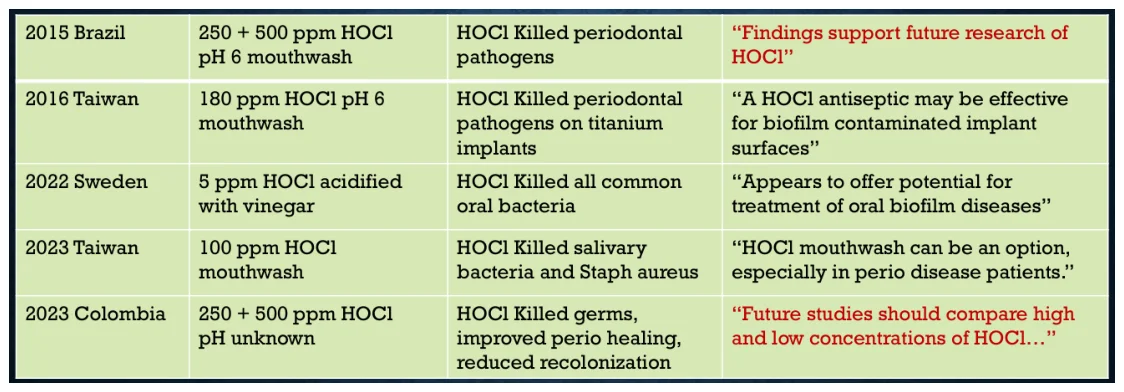
In the fifteen years since Sam and Lu outlined HOCl as both the primary neutrophil oxidant and a potential periodontal therapy, multiple clinical trials have confirmed that low‑ppm HOCl mouthwashes and irrigants reduce periodontal pathogens and improve healing—yet each ends with the same refrain that “more studies are needed,” leaving daily HOCl biofilm control absent from mainstream periodontal protocols.
- J Dent Sci 2009;4(2):45−54, “The role of hypochlorous acid as one of the reactive oxygen species in periodontal disease”, Chong-Hou Sam, Hsein-Kun Lu
- Braz. Dent. J. 26 (5) • Oct 2015 • “Viability and Effects on Bacterial Proteins by Oral Rinses with Hypochlorous Acid as Active Ingredient”
- Int. J. Mol. Sci. 2016, 17(7), 1161; “Effectiveness of Hypochlorous Acid to Reduce the Biofilms on Titanium Alloy Surfaces in Vitro”
- BMC Oral Health volume 22, Article number: 415 (2022) “Effects of stabilized hypochlorous acid on oral biofilm bacteria”
- BMC Oral Health (2023) 23:698, “Effects of hypochlorous acid mouthwash on salivary bacteria including Staphylococcus aureus”
- Antibiotics 2023, 12, 1311, “Hypochlorous Acid as a Potential Postsurgical Antimicrobial Agent in Periodontitis”
The unsurprising truth is that dentistry is running the same experiment over and over. For more than fifteen years, periodontal studies from Taiwan, Brazil, Sweden, Colombia, and elsewhere have used low‑ppm HOCl mouthwashes and irrigants—often at pH 6—to treat periodontitis, peri‑implantitis, and salivary bacterial loads. Their recurring findings can be summarized plainly:
- HOCl mouthwash at 5–250 ppm killed common oral bacteria, including periodontal pathogens, and improved clinical signs of periodontal healing and reduced recolonization.
- HOCl solutions activated with mild acids such as vinegar demonstrated robust antimicrobial activity against biofilms without eroding hydroxyapatite or harming keratinocyte viability.
- HOCl performed as well as or better than chlorhexidine against key gram‑negative species, without its staining and toxicity baggage, and was repeatedly judged suitable as a periodontal medicament or adjunct irrigant.
Yet every paper ended with the same cautious refrain: “more studies are needed.” No guideline named a standard HOCl protocol; no patient‑friendly recipe appeared; and no one told the public that a cheap, unpatentable antiseptic had quietly passed its periodontal proof‑of‑concept phase.
The biology-mimicking science did not fail; the research system did.
This chapter therefore uses those “more studies needed” conclusions as Exhibit A for a different claim: the oral biofilm problem has been solved! What is missing is a clear, repeatable regimen that ordinary families can use at home.
The next chapter will apply that kitchen‑ready recipe and translate Ono’s sterile lab solution into Searbicide—my oral antiseptic that finally completes Millers 135‑year search.
Beyond the Mouth: Other Biofilm Battlefields Await, Doctors. Please Engage.
Once the mouth becomes a disciplined HOCl‑assisted environment, the same biofilm principles apply elsewhere. Cystic fibrosis lungs are the extreme version: an HOCl desert where neutrophils cannot generate adequate phagosomal HOCl, leaving thick, DNA‑rich mucus colonized by stubborn biofilms and bathed in chronic neutrophil elastase and ROS. Chronic sinusitis, adenoidal biofilms, middle ear effusions, chronic wounds, catheters, and implants all show the same pattern—protected communities, persistent PAMP signaling, and exhausted immunity.
This book (mostly) stays in its lane by fully working out the mouth first. The proposal is not that dentists should manage CF or design ICU aerosol protocols, but that proving daily HOCl‑assisted oral biofilm control opens the door for other specialists to explore similar hygiene‑plus‑chlorine strategies on their own terrain.
In that sense, the dental biofilm is both first battlefield and training ground for Miller’s ideal antiseptic. When the mouth’s focal infection can finally be kept quiet with a simple, reproducible HOCl routine, the rest of the body’s biofilm‑driven diseases stop looking inevitable and start looking like invitations—waiting for their own version of the same missing antiseptic story.