Dr. Ono found our ideal antiseptic for a healthy mouth and nose: 50 ppm HOCl at pH 6.
- 50 ppm total chlorine water solution
- had excellent microbicidal effect
- against a broad spectrum of bacteria, fungi, virus, and spores
- in large quantities representing actual skin infections
- in a short time - dead in 15-60 SECONDS for all bacteria, fungi, and virus. Spores take 10 minutes to kill.
- Most effective at pH 6 where 97% of chlorine is in its active HOCl form.
- Hypochlorite ion is inactive as a germ killer. HOCl is the only active form so pH of antiseptic is critical.
Now you know what to do: apply a 50 ppm HOCl antiseptic solution to mouth, nose, and throat daily to eliminate persistent and repeat oro-nasal infections. You can finally heal yourself and recover your strength.
Where can you get this miraculous healer? I can’t find it at Walmart or Kroger. Physicians have no interest and do not provide it. Solution: we continue to follow Dr. Ono’s lead and we make it ourselves.
Discovery #8. Dr. Ono made his own 50 ppm HOCl by diluting a strong hypochlorite solution with lots of water and adding a small amount of strong acid to achieve the correct pH.
Ono: “Fifty ppm hypochlorous solution was prepared by diluting 12% sodium hypochlorite with tap water. The pH value of the solution was adjusted to pH 5, 6, 7, or 8 with HCl or NaOH.”
Pure HOCl can be made by diluting bleach with tap water and adding a touch of acid.
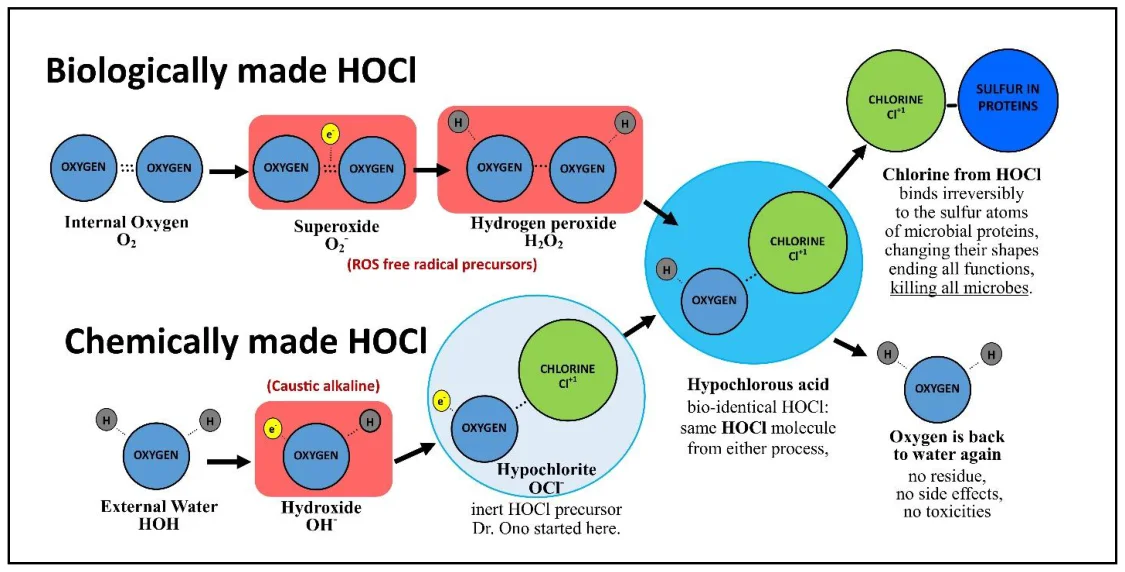
We’ve covered the biochemical process by which white blood cells make HOCl via the ROS route. Below we see the alternate electrochemical process by which Clorox makes hypochlorite and Dr. Ono transforms that into a 97% pure solution of 50 ppm HOCl at pH 6.
Either method yields the exact same HOCl molecule. We can make our own medical- grade HOCl antiseptic solution in the kitchen.
1. Ono’s discovery: the ideal antiseptic: 50 ppm HOCl
Dr. Ono identified an antiseptic that is almost a blueprint for healthy mouth and nose care: a 50 ppm hypochlorous acid (HOCl) solution at about pH 6. At that concentration and pH, the solution showed excellent microbicidal activity against a broad spectrum of bacteria, fungi, viruses, and even spores, using real-world quantities of organisms that mimic actual skin and wound infections. In Ono’s hands, bacteria, fungi, and viruses were killed in 15–60 seconds, while hardy spores required about 10 minutes of contact. At pH 6, roughly 97 percent of the chlorine is in the active HOCl form, while the hypochlorite ion is largely inactive as a germ killer, which makes pH control critical.
2. What a 50 ppm HOCl rinse can do
Once that biochemistry is understood, the practical implication is simple: applying a 50 ppm HOCl solution to the mouth, nose, and throat daily can strip away persistent and repeat oro-nasal infections that keep the immune system in constant low-grade battle. A rinse like this does not “boost” immunity; it removes the microbial workload so the system can finally rest and repair. In principle, that kind of daily decontamination lets older adults heal more fully between illnesses and recover strength instead of being dragged down by chronic mucosal infections.
3. Why we must make it ourselves
So where does one get this “miraculous healer”? It does not sit on the shelves at Walmart, and most physicians neither prescribe nor stock it because it falls into a regulatory gray zone between wound irrigation solutions and surface disinfectants. Commercial HOCl products exist, but they are often expensive, inconsistently labeled, or locked inside hospital supply chains. The practical conclusion is unavoidable: if everyday people and families are to have reliable access to ideal HOCl for mucosal hygiene, they will have to make it themselves at home.
4. Ono’s lab method: concentrated bleach plus strong acid
Ono’s paper gives a straightforward recipe for his 50 ppm solutions. He prepared a “50 ppm hypochlorous solution” by diluting 12 percent sodium hypochlorite with tap water, then adjusting the pH to 5, 6, 7, or 8 with concentrated hydrochloric acid (HCl) or sodium hydroxide. In practice, for a 500 ml batch, he used only a few drops of the 12 percent bleach stock to reach 50 ppm total chlorine, then nudged the pH into his target zone with precise acid or base additions. Chemically, this produces the same HOCl molecule that neutrophils forge from chloride and hydrogen peroxide; electrically or biochemically, the end product is identical.
5. Why that lab method is wrong for kitchens
While Ono’s method is elegant in the lab, it is not acceptable in a home kitchen. A 12 percent hypochlorite stock and concentrated HCl are both hazardous chemicals: a splash can burn skin or eyes, fumes can damage lungs, and small measurement errors can swing pH into damaging territory. At the same time, the finished product we want is very dilute and barely acidic—something closer to rainwater than drain cleaner. There is no reason to bring industrial-strength reagents into a household just to end up with a 50 ppm, pH-6 solution. For home use, both the chlorine source and the acidifier must be much gentler.
6. A safer adaptation: diluting household bleach and pH adjusting with vinegar
The safer path is to keep Ono’s targets but swap his reagents. Instead of 12 percent hypochlorite, we use standard household disinfecting bleach at 7.5 percent or 5 percent available chlorine. Instead of concentrated hydrochloric acid, we use kitchen vinegar at about 5 percent acetic acid.
- With 7.5 percent bleach: to make 500 ml of ~50 ppm total chlorine, add about 6 drops of bleach to 500 ml of clean tap water.
- With 5 percent bleach: to make the same 500 ml of ~50 ppm, add about 10 drops of bleach to 500 ml of water.
Those tiny volumes of bleach yield a slightly alkaline solution around pH 8, where only about 24 percent of the chlorine is present as active HOCl; the rest is relatively inactive hypochlorite ion. To fully activate the solution, a second step is needed: gentle acidification.
Instead of HCl, we add an equal number of drops of ordinary vinegar (5 percent acetic acid) to the chlorine solution. Matching drops of vinegar to bleach—6 and 6, or 10 and 10—brings the pH down into the neighborhood of 6, about the acidity of clean rainwater or a mildly sour beverage. In that zone, roughly 97 percent of the chlorine exists as HOCl, giving you a kitchen-made solution that closely matches Ono’s 50 ppm, pH-6 antiseptic in both concentration and activity.
7. From kitchen jug to immune relief
With those two steps, Ono’s laboratory recipe is translated into a domestic protocol: a few drops of standard bleach, a matching number of drops of vinegar, and half a liter of tap water yield a 50 ppm, HOCl-rich rinse that is strong enough to kill a wide range of pathogens but gentle enough for daily mouth and nose use. The same logic can scale up to gallon jugs and to other ppm levels, such as 100 ppm or 300 ppm, which are useful for heavier contamination and for soaking devices or dentures.
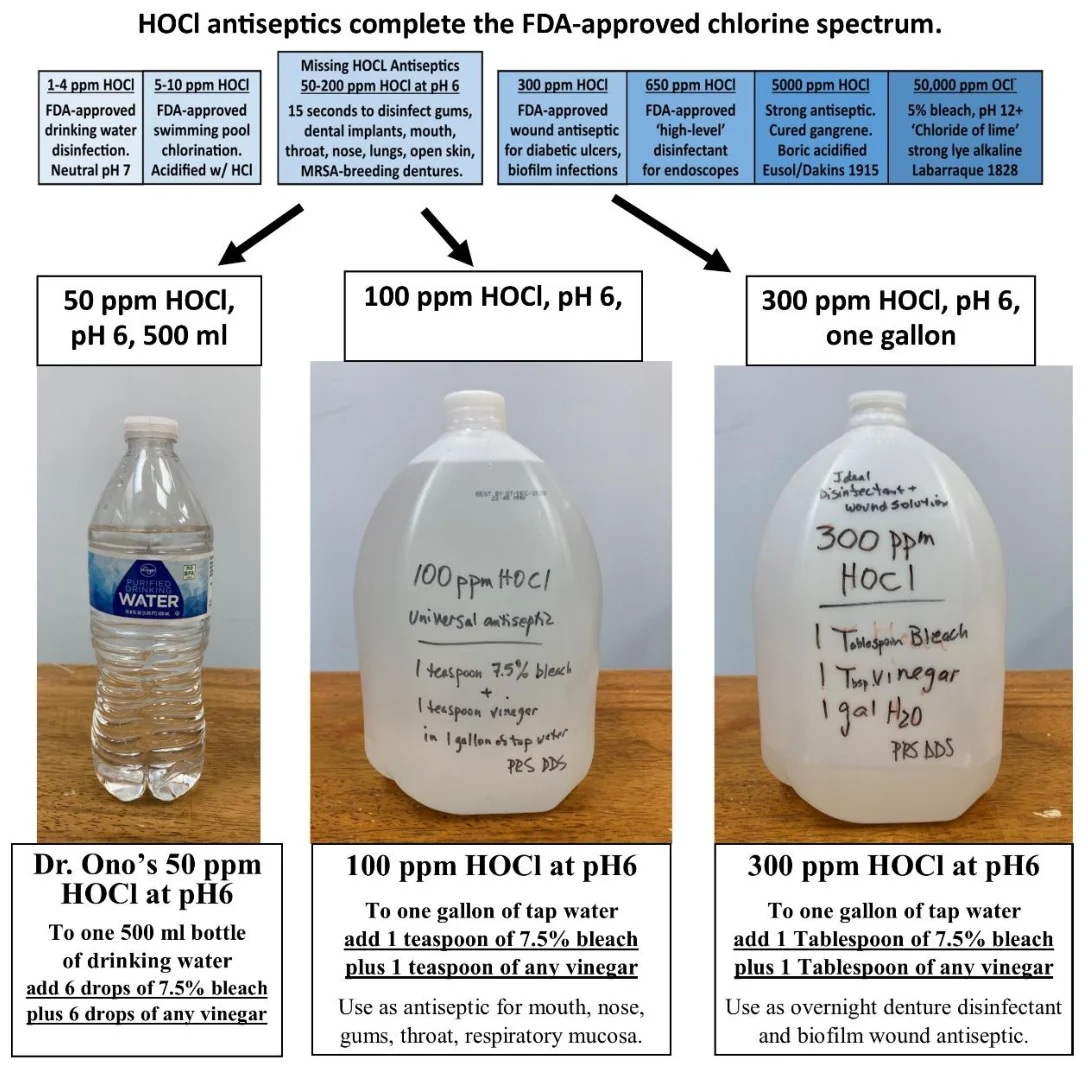
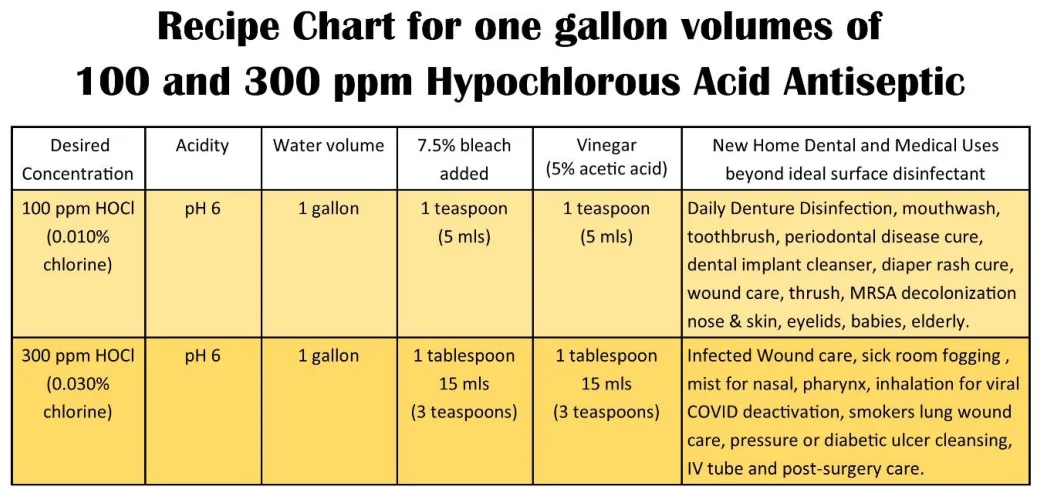
Searbicide = 50–150 ppm HOCl antiseptic at about pH 6 in clean water
Hypochlorous acid is very good stuff, but Good Lord, it needs a better name. I’m calling it Searbicide. Rhymes with herbicide. From now to all eternity, when you mix up 50-100-150 ppm HOCl antiseptic solutions at home, you have made yourself Searbicide.
The biochemistry now points in a very simple direction: if a 50–100 ppm HOCl solution at about pH 6 behaves like the body’s own chlorine, then ordinary families ought to be able to keep that medicine chest stocked at home.
What Miller lacked was not theory but a kitchen ready formula, something a retired schoolteacher or a tired caregiver could mix without a lab coat.
Once you can reliably mix a gallon of 50–100 ppm “Searbicide” and as needed, a stronger 300 ppm HOCl modeled on FDA-approved wound solutions, you are no longer stuck at the kitchen counter with an interesting chemistry project.
You are standing at the edge of something far more important: a personal, daily way to lighten your immune system’s workload by cleaning up the very borders where most of your battles begin. A jug of antiseptic is only potential energy; the real change happens when that chlorine water meets teeth, tongue, gums, dentures, nasal lining, and throat in a disciplined routine.
The next step, therefore, is not another recipe but a strategy: how to use these gentle HOCl rinses to upgrade barrier hygiene at the mouth and upper airway so that infections become smaller, rarer, and shorter.
8. Why no HOCl solution can sit active on a shelf forever. It always fades away.
HOCl is said to be unstable and that is true. It disappears over time – even in a closed container in the dark. Even in the cleanest tap water you can find — no bacteria, no protein, no dirt, nothing to “use up” the chlorine — a dilute HOCl solution will still slowly decompose. It has nothing external to react with so it reacts with itself.
This is not a flaw in our recipe. It is not a flaw in any commercial product either. It is the nature of the chlorine atom sitting at the +1 oxidation state, and no amount of clever engineering — mine or a Fortune 500 chemist’s — is going to repeal it. Once you understand why, you stop chasing permanence and start doing the one thing that actually works: making it fresh and using it while it’s strong.
9. Chlorine attacking chlorine: self-disproportionation
In HOCl, the chlorine atom is oxidized to the +1 state — it has given up an electron compared to chloride’s −1, but not as much as the +5 chlorine sitting in chlorate. That in-between position is unstable. Chlorine at +1 has two directions it would rather go: down to −1 (chloride, Cl⁻) or up to +5 (chlorate, ClO₃⁻). Left alone in water, HOCl finds a way to do both at once, using nothing but itself as the reactant:
3 HOCl → 3 H⁺ + 2 Cl⁻ + ClO₃⁻
Read that equation slowly. Three molecules of HOCl go in. Two of their chlorine atoms come out reduced to chloride, and one comes out oxidized to chlorate. Chemists call this disproportionation: the same element oxidizing and reducing itself in the same reaction, with no help from bacteria, sunlight, or dirt required. Chlorine is, in a sense, chemically restless at +1 and is always looking for other chlorine to react with to settle into more comfortable oxidation states.
Deborde and von Gunten’s exhaustive 2008 review of aqueous chlorine chemistry catalogs just how reactive the HOCl/OCl⁻ system is — with organics, with inorganics, and, given the chance, with itself.
Strip away the organics and the inorganics — the contamination we can control by using clean water— and the self-reaction above is what’s left standing. It is the floor, not the ceiling, of chlorine’s instability.
10. To maximize stability, keep HOCl away from heat, air, UV/sunlight and contaminants
Two independent groups have put this chemistry to the test on real HOCl solutions sitting on real shelves, and both arrive at the same practical map.
Ishihara and colleagues tracked weakly acidic HOCl under different stress conditions and found that container, light, and temperature — not the presence of contamination alone — determine how fast a “clean” solution fails:
| Stress removed | Effect on stability |
|---|---|
| Air contact | Slower decline when sealed |
| UV / direct sunlight | The single biggest accelerant — shielded, dark samples showed essentially zero loss over 8 hours; unshielded samples in sunlight collapsed within hours |
| Heat | Half-life of a 200→100 ppm decline in pure water was 24 weeks at 4°C — but only 2 weeks in pond water at the same temperature |
| Organic / ionic load | Proteins, nitrite, sulfite, iron, and copper ions cut the half-life to under 10 minutes to a few hours at 37°C |
Ishihara et al., Biocontrol Science, 2017: https://doi.org/10.4265/bio.22.223
Their own conclusion is the same dual instruction covered earlier in this chapter’s storage guidance: use pure water, and keep your HOCl solution cold and dark.
Nagamatsu and colleagues, working with neutral-pH electrolyzed water preparations, stored samples for 126 days under every combination of light/shade and room- temperature/refrigeration. Even in the best condition tested — shaded and refrigerated — available chlorine concentration still declined over time. Nothing on the shelf escapes the chemistry above; refrigeration and darkness only rent you more time before it catches up.
Nagamatsu et al., Applied Sciences, 2024: https://doi.org/10.3390/app14209264
11. Concentration is the one dial you actually control and dilute HOCl lasts longer.
Here is the most useful thing the Nagamatsu data give us. Across their formulations, the higher-concentration solutions decayed faster — the correlation between starting concentration and rate of decline ran as strong as −0.887 under their best storage condition. In plain language: a strong solution has more restless Cl(+1) atoms per liter looking for another chlorine atom to react with, so it finds itself faster. A dilute solution has fewer, and proceeds more slowly.
This is not a minor footnote — it is the whole game. You cannot buy your way out of Cl(+1) instability with a better bottle or a darker cabinet alone. But you can choose to keep your working solution dilute (Ono’s 50–150 ppm Searbicide range, not an industrial-strength stock) and you can choose to make small, frequent batches instead of one giant reservoir that sits for months. Both choices work with the chemistry instead of against it.
12. Why commercial dilute chlorine products hit the same wall
This is also why you will never find a shelf-stable, ready-to-use, dilute HOCl antiseptic sitting next to the mouthwash at Walmart with a two-year expiration date. It isn’t for lack of trying, and it isn’t a marketing failure.
Every commercial “stabilized” hypochlorous product — however it is branded, whatever exotic name is stapled to it — is fighting the identical 3 HOCl → 3H⁺ + 2Cl⁻ + ClO₃⁻ reaction that your kitchen jug is fighting. Stabilizer chemistry, better packaging, tighter pH control, and cold-chain shipping can all push the clock back — but none of it repeals disproportionation. A dilute chlorine antiseptic with a long, generous shelf life is not a product anyone has failed to invent yet. It is a product that cannot exist, because the chemistry underneath it won’t allow it. Expect that ceiling to still be there in ten years, in fifty years, no matter who claims otherwise on the label.
That is precisely why Ono, and now this book, both land on the same answer: if you want reliable, potent HOCl on your bathroom counter, you make it yourself, and you make it often. Nobody is going to sell you a permanent workaround, because the workaround does not exist.
13. We make chlorinated rainwater. They sell chlorinated seawater
I want to leave you with an image, because it captures the difference between what I’m asking you to make and what the “electrolyzed water” machines on the market are selling you.
Your Searbicide recipe starts from clean tap water — a handful of drops of ordinary bleach, a matching handful of drops of vinegar, nothing else. Low mineral content, low ionic load, mild acidity. Chemically, that is close to chlorinated rainwater: gentle, clean, and exactly what you’d want cleansing your gums, tongue, and throat every day.
Commercial “electrolyzed water,” “super-oxidized water,” and “hydrolyzed water” devices, by contrast, typically start from a concentrated salt brine — often literally seawater- strength sodium chloride — and run an electric current through it to generate hypochlorous acid on demand. The end molecule is the same HOCl. But the water it’s swimming in is not the same water: it carries the residual ionic load of a brine solution, the byproducts of electrolysis, and often a higher total dissolved solids count than anything you’d choose to put in your mouth voluntarily. Nobody drinks or rinses with seawater, and dressing it up as “electrolyzed” doesn’t change what it started as.
Chlorinated rainwater for daily oral use. Chlorinated seawater for the industrial disinfectant tank. Both are legitimate uses of the same chemistry — but only one of them belongs in your Searbicide jug.
This is the first arm of my proposed Chlorine Therapy, where external HOCl cooperates with the body’s own chlorine triad to strip away virulence proteins at the surface, quiet chronic PAMP and DAMP signaling, and give the immune war machine more days in peace than in war.
In the chapters that follow, mucosal hygiene becomes practical—how to swish, spray, soak, and irrigate with 50–300 ppm HOCl so that “a gallon of homemade antiseptic” turns into stronger borders, calmer inflammation, and a measurable return of immune reserve.