Pathogenesis refers to the overall biological process of disease development, while virulence specifically describes the degree of damage a pathogen can cause to its host.
During the process of infection, virulence factors of microorganisms combat with defense mechanisms of the host (us). If virulence factors overcome the defenses of the host, then infection is established otherwise the pathogens are eliminated from the host.
Persistent infections always involve the most virulent, therefore the most successful pathogens. An abundance of effective virulence factors are what enable these super-pathogens to successfully invade mucosa cells, avoid defensive immune responses and cause disease.
Virulence factors can be any molecule or structural component that helps a pathogen invade, survive, and harm the host. Many virulence factors are proteins, including bacterial toxins (like tetanus toxin), enzymes (such as proteases that degrade host tissues), and adhesion molecules that help pathogens stick to cells.
All pathogens attack us in five steps: Approach, Adhesion, Invasion, Replication, Spread
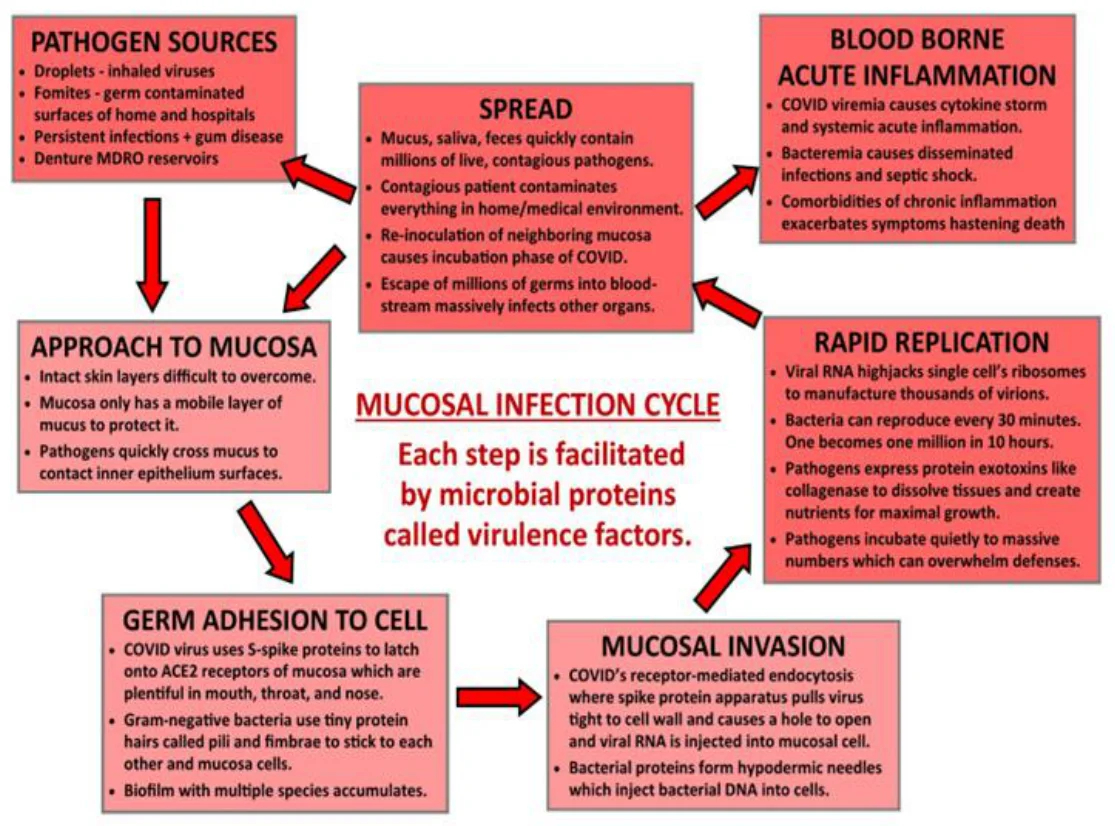
Pathogens use protein tools and weapons
This is war.
The microbial mob storms our mucosal castle using virulence factors that function like microscopic pitchforks, knives, axes, and scissors – cutting, dissolving, or bypassing our barriers so they can colonize deep inside us.
There is no middle ground: it is us or them. There are millions of pathogenic strains, each drawing from a shared toolbox of protein weapons that work exceedingly well.
Collagen is a wondrous protein “micro-rope” that binds our cells together and gives tissues strength. The bacterial enzyme collagenase snips these connections like butter, allowing Staphylococcus aureus to penetrate deeper.
Exotoxins from organisms such as Pseudomonas punch holes in cell membranes like soap bubbles, spilling cell contents, feeding the invader, and triggering massive inflammation.
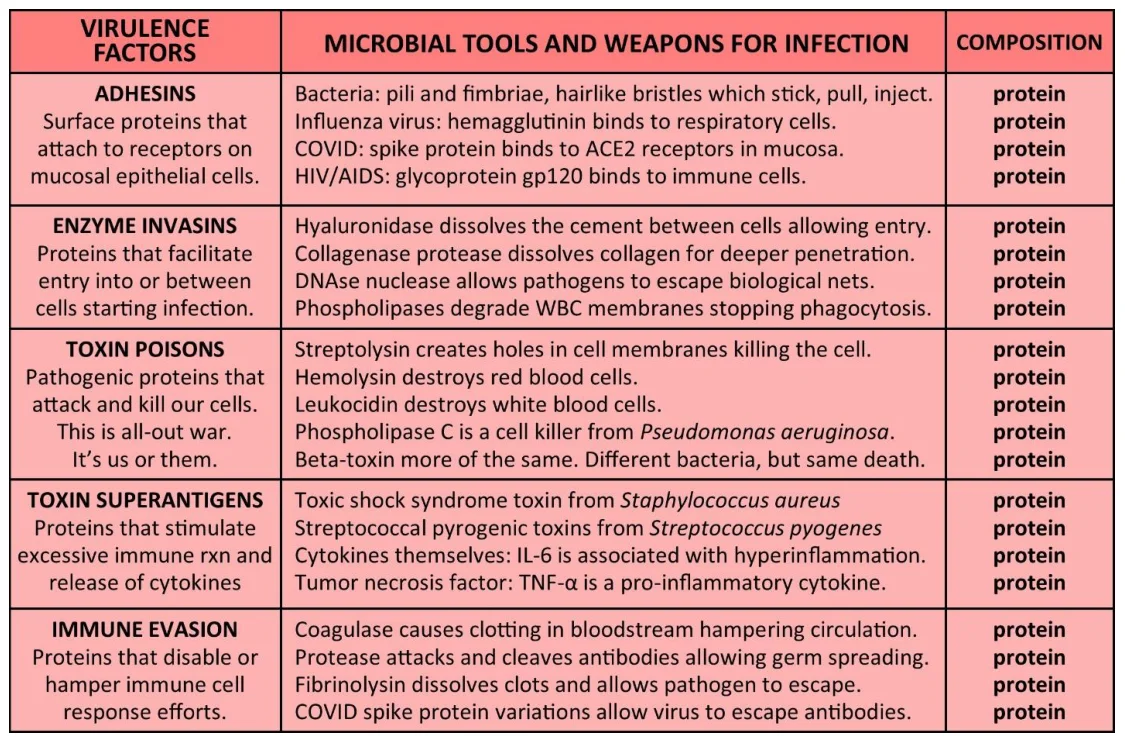
Virulence factors really are the knives, hooks, and poisons pathogens use to infect us. At every step of mucosal infection, they rely on proteins:
- Protein adhesins to stick to epithelial cells
- Protein invasion enzymes to digest and bypass our defenses
- Protein toxins to kill host cells, especially immune cells
- Protein superantigens to whip up destructive inflammation
- Protein tricks for immune confusion and evasion Microbes are one-trick ponies in this sense, but it is an extremely effective trick: correctly folded virulence proteins do almost all the damage.
Worst news: antibiotic resistance is a contagious virulence factor
As if offensive virulence factors were not enough, bacteria have evolved defensive protein tools that specifically inactivate antibiotics. Worse, they share the DNA blueprints for these enzymes with other bacteria.
“Gentle” or previously mild organisms can be “infected” with DNA fragments that add new virulence and resistance traits, like a zombie bite transforming an ordinary citizen into a monster. Drug resistance is contagious in this genetic sense.
At first, drug resistance was blamed on rare mutations passed only to a bacterium’s descendants. The reality is far more alarming: resistance genes are traded among bacteria in mixed infections and biofilms like cheat codes shared in an online game.
Roughly a quarter of pathogenic bacterial DNA is mobile and exchangeable. Small DNA elements – plasmids and bacteriophages – ferry protein-coding instructions from cell to cell, letting bacteria rapidly add new virulence factors and resistance mechanisms.
This swap of DNA happens fastest when germs live together in dense, long-term communities: chronic wounds, sinus tracts, dental plaque, and dentures worn 24/7. In these reservoirs, species sit in “genetic conjunction,” quietly upgrading one another’s arsenals.
Once acquired, resistance proteins can:
- Cut the antibiotic into harmless fragments (as with classic penicillinases)
- Chemically alter the antibiotic or its target site
- Pump the drug back out of the cell before it can act
In effect, we mass-produce microbial virulence factors and fire them back at microbes, only to watch them evolve counter-weapons. From the pathogen’s perspective, antibiotics are just one more environmental threat to outsmart.
In 1928, Fleming noticed that Penicillium mold secreted a factor that suppressed Staphylococcus aureus, and by 1943 humans were fermenting 21 billion units of penicillin a year to save World War II soldiers from wound infections. Without antibiotics or chlorine antiseptics, severe staph infections historically killed about 80 percent of victims.
But there was a design flaw from the beginning. Penicillin was never meant to kill Penicillium itself, and no naturally made antibiotic is 100 percent germicidal – it is selective pressure, not a final solution.
Soon S. aureus evolved and disseminated the gene for a penicillin-snipping enzyme throughout the microbial world. Doctors now blame “overuse” of antibiotics, especially in clinical practice, but that misses the larger reality.
Human medicine is only one piece of the puzzle. Millions of metric tons of antibiotics have been poured into agriculture, aquaculture, and animal feed, creating constant pressure on microbes to evolve and share antibiotic resistance.
That pressure is never going away. Antibiotics were always destined to be temporary tools; acquired resistance is the default response of bacterial communities, not the exception.
MRSA and the ESKAPE superbugs
MRSA – methicillin-resistant Staphylococcus aureus – is the poster child of this problem. If we can tame this single organism and its reservoirs, we can change the trajectory of hospital infections.
Staph aureus is ubiquitous, highly contagious, and well adapted to skin and surfaces, especially in ICUs and sickrooms. Any break in the skin – wounds, IV sites, catheters – is a portal for MRSA, which historically caused lethal sepsis, endocarditis, and soft-tissue infections before the antibiotic era.
In the 1800’s, “trivial” skin wounds often led to grave trouble; that same dynamic now plays out with modern MRSA. Today it leads the pack in four major categories:
- Bacteremia and sepsis
- Endocarditis
- Skin and soft tissue infections
- Hospital-acquired infections, most now multi-drug resistant
Hospital-adapted MRSA strains are increasingly appearing in the community as CA-MRSA, blurring the line between hospital and home. Alongside MRSA stands the infamous ESKAPE group of hospital superbugs: Enterococcus faecium, Staphylococcus aureus, Klebsiella pneumoniae, Acinetobacter baumannii, Pseudomonas aeruginosa, and Enterobacter.
Through mutation and gene sharing, ESKAPE organisms now resist nearly all major antibiotic classes – including “last line” agents like carbapenems, glycopeptides, and polymyxins. In the United States alone, there are more than 2 million multi-drug-resistant infections annually, causing tens of thousands of deaths and billions in healthcare costs.
Those most at risk of drug-resistant infections include:
- Inpatients with surgery, devices, or catheters
- Families exposed to infected wounds and secretions
- Immunocompromised individuals
- People with chronic systemic inflammation and exhausted immunity
- Residents of long-term care facilities who shuttle between nursing homes and ICUs
Persistent MRSA infections convert patients into MRSA carriers – sometimes with few symptoms – who continuously seed their surroundings with staph. This “silent carriage” contaminates homes, nursing facilities, and ICU surfaces and sets up the next wave of infections.
By 1990, about 22 percent of nursing home residents were MRSA carriers; recent work suggests the figure now exceeds 50 percent in some facilities. That means every other resident can be quietly growing MRSA in the nose, armpits, groin, or mouth.
During the COVID surges, more elderly people cycled through hospitals and ICUs; MRSA rates climbed in parallel. Elderly MRSA carriers became the unwitting engine of ongoing contamination in wards and nursing homes.
Bacterial Pathogen Reservoirs: where the war is really lost
To break this cycle, we must eliminate both MRSA carriers and MRSA reservoirs. Virulent pathogens like MRSA persist only when they have protected spaces to hide, breed, and trade resistance genes.
Reservoirs we finally learned to sanitize or isolate – usually with chlorine – include sewage, drinking water, corpses, filthy hospitals, dirty hands, and surgical instruments.
But several modern reservoirs still fuel the ESKAPE pandemic:
- Symptomatic carriers with draining, purulent infections,
- Fomites – contaminated rooms, equipment, and household surfaces,
- Asymptomatic carriers with hidden, chronic focal infections,
- Unsterilized Dentures and oral biofilms in older adults.
A 2021 study showed that nearly half of nursing home residents had MRSA colonies in the nose, armpits, or groin. With that level of carriage, hospitals cannot eradicate MRSA as long as it walks in on every other elderly admission.
Plastic dentures are a particularly neglected reservoir. Every ESKAPE pathogen has been isolated from denture biofilms, and elderly patients frequently harbor dense, mixed-species colonies on their plates.
As early as 1997, investigators warned that ignoring MRSA on dentures would doom eradication efforts. Still, mainstream medicine and dentistry have largely looked away.
In one 2015 study, denture plaque contained around 10 million colony-forming units per gram, with S. aureus at roughly 100,000 CFU/g – about the same threshold used to diagnose a urinary tract infection in urine. Wearing an unsterilized denture is biologically similar to having a persistent staph UTI in your mouth 24 hours a day.
By neglecting chronic oral and mucosal infections – and the dentures riding on top of them – we have helped create the current MRSA epidemic. The germs are not just “out there”; they are living in and on us, turning our bodies and devices into breeding grounds.
We are increasingly living in microbial filth without realizing it. If we want to protect our exhausted immune systems, we must reduce these focal reservoirs, starting with the mouth and upper airway.