A Mom’s View: Why Skin Is Your First Line of Defense
You already know that skin is a barrier. It keeps the germs out, holds moisture in, and protects everything underneath. When it’s intact, it’s tough — like a living, breathing suit of armor. But the moment it’s broken, everything changes. A small cut, a scrape, a pressure sore, a catheter site, or even a surgical incision that won’t quite close — that’s no longer just a “boo- boo.” That’s an open door.
Inside the body, the immune system is constantly making its own antiseptic: hypochlorous acid (HOCl). It’s what neutrophils use to kill bacteria, viruses, and fungi. It’s also involved in cleaning up dead tissue and signaling the body to start healing. Nature didn’t give us HOCl because it’s harsh or dangerous; it gave us HOCl because it’s precise, fast, and safe at the right concentration.
So why not help your family by killing germs from the outside, before infections?
At home, we already use antiseptics on cuts and scrapes. But many of them sting, dry the skin, or leave behind residues that can irritate. HOCl, in a properly made, pH-neutral, dilute solution, doesn’t do that. It’s gentle enough for daily use, even on sensitive skin, yet strong enough to kill the usual suspects: staph, strep, E. coli, and even some fungi. It doesn’t harm healthy tissue, and it doesn’t disrupt the skin’s natural barrier when used correctly.
For families, this matters in real, everyday ways:
- A child with eczema or atopic dermatitis who’s prone to skin infections.
- An older adult with thin, fragile skin and slow-healing sores.
- Someone with a feeding tube, catheter, or IV line at home.
- A diabetic with foot ulcers or recurrent skin breakdown.
- A post-op patient recovering at home with incisions or drains.
In all of these cases, the skin is no longer just a passive barrier. It’s an active battlefield. And HOCl, used as a rinse, spray, or soak, can be part of the daily routine — not just when something is “infected,” but as a way to keep the skin environment clean, calm, and ready to heal.
Think of it like brushing teeth: you don’t wait for a cavity to start brushing. You brush every day to prevent decay. HOCl skin hygiene is the same idea — a gentle, daily “rinse” for the skin that supports the body’s own defenses instead of fighting against them.
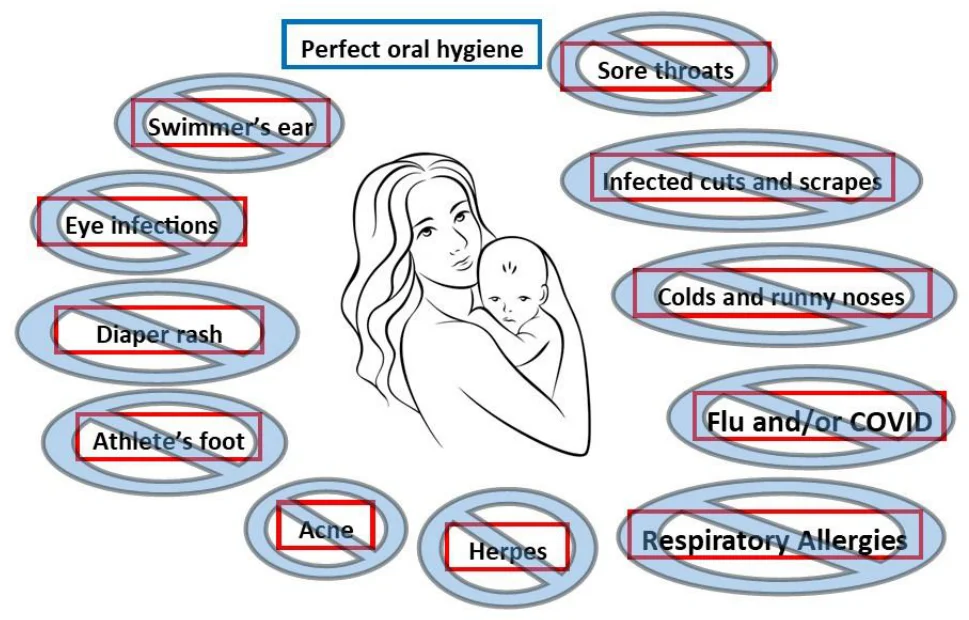
Perfect oral and skin hygiene with a gentle HOCl spray gives caregivers a single, simple tool they can use from diaper changes to teen acne. Used at about 100 ppm on clean skin, it supports the body’s own defenses without stinging or damaging healing tissue.
Common skin problems where topical HOCl can help
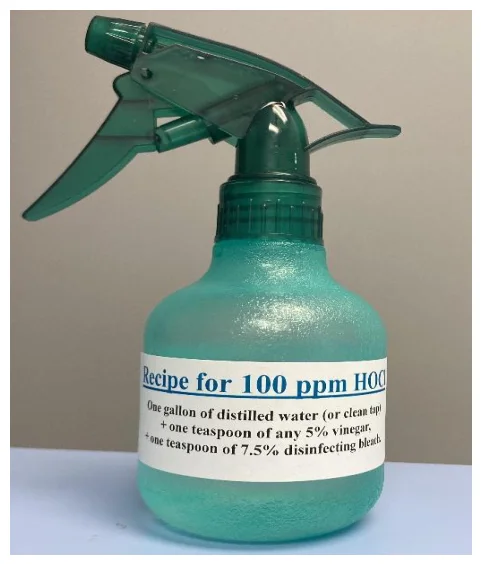
Below are everyday situations a mom or home caretaker actually sees, with simple 100 ppm HOCl antiseptic instructions.
Everyday skin and mucosal troubles with HOCl recommendations from Dermatologists
| Skin Problem (child / family) | Typical cause or setting | How to use 100 ppm HOCl | Caretaker Notes / cautions |
|---|---|---|---|
| Diaper rash (irritant or mild secondary infection) | Moisture, friction, stool enzymes, Candida overgrowth. | After every diaper change: gently clean, then mist or dab HOCl on the rash area, allow to air‑dry, then apply barrier cream as usual. | Do not skip barrier cream; see pediatrician if rash lasts >3 days, blisters, or child is very uncomfortable. |
| Infected cuts and scrapes | Minor breaks in skin, often on knees, hands, feet; may crust or ooze. | Rinse visible dirt, then soak or spray with HOCl for 30–60 seconds, let air‑dry, and cover with a clean bandage. Repeat 2–3 times daily until healed. | Seek urgent care for deep, gaping, or rapidly spreading redness, or if fever develops. |
| Impetigo‑type crusty sores around nose/mouth | Highly contagious staph or strep infection. | Clean crusts with warm water, then spray HOCl, allow to dry, and keep loosely covered. Use 2–4 times daily around and between prescribed antibiotic applications. | Always call pediatrician; systemic or topical antibiotics are usually required. |
| Athlete’s foot / ringworm patches | Fungal infection between toes, on feet, or body skin. | After washing and drying, spray HOCl over and slightly beyond the rash margin, let dry before socks or shoes. Use twice daily with or after antifungal cream. | Persistent or widespread fungal infection needs medical evaluation. |
| Acne flares (pre‑teens/teens) | Clogged pores and bacterial overgrowth on face, shoulders, back. | After gentle cleansing, mist HOCl over breakout areas, let dry, then apply non‑comedogenic moisturizer or acne medication. Use 1–2 times daily. | Avoid harsh scrubs or multiple strong acids with HOCl on very sensitive skin. |
| Herpes cold sores | Recurrent viral blisters on lips and nearby skin. | At first tingle, spray HOCl 3–4 times daily after gently blotting the area; allow to dry before lip balm or antiviral cream. | Antiviral meds shorten outbreaks; see clinician for frequent or severe sores. |
| Swimmer’s ear outer‑ear irritation (not deep infection) | Moisture‑related irritation of outer ear canal skin. | With child upright, lightly mist HOCl on outer ear and entrance to canal (do not force liquid deep inside), then let it run out and dry. | True otitis externa or any ear pain with fever or drainage needs a clinician; do not self‑treat suspected ear infection. |
| Eye‑area skin irritation (not eyeball) | Rubbing, tears, eczema around lids. | Spray HOCl on a clean cotton pad and gently dab the skin around, but not directly into, the eye; 1–2 times daily. | Red, painful eyes, light sensitivity, or vision changes require prompt eye‑care evaluation. |
| “Wet” nostrils, colds and runny noses (skin only) | Irritated skin under nose from wiping; high germ burden around nares. | Gently wipe mucus away, then mist HOCl on a tissue and dab around nostrils and upper lip; let dry, then apply plain ointment to protect skin. | Internal nasal sprays or decolonization protocols should follow clinician guidance in high‑risk kids. |
| Mild eczema / atopic dermatitis flare with broken skin | Dry, itchy, inflamed patches prone to infection. | After lukewarm bath and gentle pat‑dry, lightly spray HOCl over oozing or open areas, allow to dry, then immediately apply thick emollient. | Children with widespread or infected eczema need medical care and often prescription therapy. |
| Minor household burns, chafing, or shaving nicks (older kids/parents) | Heat, friction, or razor irritation with surface break. | Cool the area with water first; once cooled, spray HOCl, let dry, then cover lightly with non‑stick dressing or moisturizer as directed by clinician. | Serious burns, blistering over joints/face/genitals, or large areas always require emergency care. |
Simple rules for HOCl antisepsis use at home.
- Use 100 ppm HOCl only on clean skin; think of it as a no‑sting “rinse” that can be used several times per day on problem spots.
- Let it stay in contact for at least 30 seconds and air‑dry whenever possible before putting on creams, bandages, or clothing.
- For anything deep, rapidly worsening, very painful, or accompanied by fever, HOCl is a support, not a substitute for professional care; parents should call their child’s clinician promptly.
Chlorine‑assisted skin hygiene means treating the skin like a living, breathing organ that deserves the same daily respect as teeth. The routine is remarkably straightforward: cleanse gently with water, spray or pat on a fine mist of neutral HOCl, give it half a minute to work, then protect with whatever barrier or moisturizer is appropriate for that area.
On intact skin—hands, feet, face—HOCl becomes a no‑sting “hand‑washing plus” that reaches into the tiny cracks where microbes hide.
On minor breaks—scrapes, razor nicks, chafing—it replaces the burn of alcohol with a neutral, salty solution that cleans without punishing the child for getting hurt.
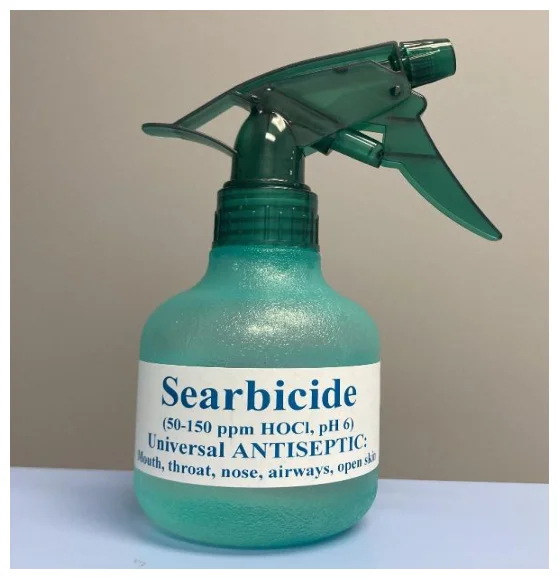
Around orifices—the nostrils, the lips, the perianal skin—it quietly lowers the germ burden without disturbing delicate tissues. Used this way, Searbicide turns the home into a low‑biofilm zone: fewer colonized scabs to pick, fewer crusted impetigo patches, fewer superinfected eczema flares, fewer hurried after‑school clinic visits.
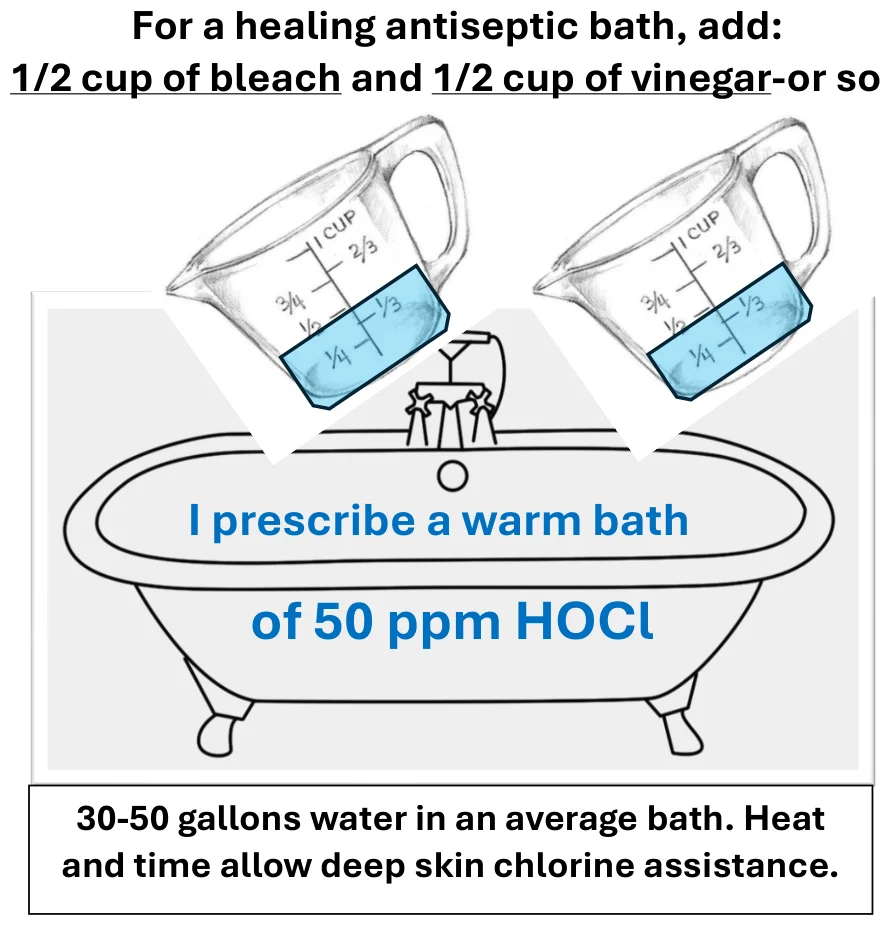
Text in this figure
For a healing antiseptic bath, add: 1/2 cup of bleach and 1/2 cup of vinegar-or so of 50 ppm HOCl I prescribe a warm bath 30-50 gallons water in an average bath. Heat and time allow deep skin chlorine assistance.
For Clinicians: HOCl as Proposed Universal Skin Antiseptic and HAI Prevention
Intact skin is one of the most effective physical and immunological barriers in the human body. Its stratum corneum, lipid matrix, and resident microbiome work in concert to exclude pathogens and limit translocation. In contrast, mucosal surfaces are inherently more permeable and constantly exposed to high microbial loads, making them vulnerable to colonization and invasion. When skin is breached — whether by trauma, surgery, indwelling devices (IVs, catheters, shunts), or chronic wounds (pressure injuries, diabetic ulcers) — that barrier is lost, and the risk of local infection and systemic spread rises dramatically.
The immune system responds by generating hypochlorous acid (HOCl) via the myeloperoxidase (MPO) system in neutrophils. Endogenous HOCl is a potent, broad-spectrum antimicrobial that also plays a role in modulating inflammation and promoting tissue repair. It is not merely a “disinfectant” but a signaling molecule that helps orchestrate the transition from pro-inflammatory to pro-repair phases of wound healing.
Exogenous HOCl, when properly formulated (dilute, pH-neutral, free of stabilizers and surfactants), mirrors this physiology. It is:
- Rapidly microbicidal against bacteria (including MRSA, VRE, ESBL), viruses, and fungi.
- Non-cytotoxic to fibroblasts and keratinocytes at clinical concentrations.
- Compatible with moist wound healing and does not impair re-epithelialization.
- Effective against biofilms, especially when used in sustained or repeated exposure protocols.
There are no documented cases in the medical literature of harm from properly formulated, dilute, pH-neutral HOCl solutions when used topically on skin or wounds. This safety profile is in stark contrast to many traditional antiseptics (e.g., povidone-iodine, alcohol, high- concentration chlorhexidine), which can be cytotoxic, delay healing, or promote resistance.
Historically, EUSOL (Edinburgh University Solution of Lime) was an early, high-dose HOCl-based solution used for heavily colonized or necrotic wounds. While its concentration and pH were far from ideal by modern standards, it demonstrated the principle: HOCl can be used aggressively in high-burden biofilm situations without destroying viable tissue when applied appropriately.
Today, the most extreme biofilm and colonization challenges are not in the community but in the hospital: multidrug-resistant organisms (MDROs) and healthcare-associated infections (HAIs). These are fueled by:
- Persistent environmental contamination.
- Colonized patients (nares, skin, oropharynx) serving as reservoirs.
- Breached skin barriers (surgical sites, catheters, pressure injuries) acting as entry points.
Chlorhexidine bathing has been widely adopted to reduce HAIs, but its efficacy is limited by:
- Incomplete skin coverage and adherence issues.
- Development of tolerance and resistance in some organisms.
- Skin irritation and contact dermatitis, especially in fragile populations.
- Limited penetration into biofilms and mucosal niches.
A universal skin antiseptic strategy based on HOCl could address these gaps:
- Daily HOCl skin hygiene (spray or wipe) for all hospitalized patients, especially those at high risk for MDROs or HAIs (ICU, post-op, immunocompromised, long-term catheters/lines).
- Targeted HOCl use at device sites (central lines, urinary catheters, surgical drains, shunts) to reduce biofilm formation and local colonization.
- HOCl-based decolonization protocols that combine:
- Nasal HOCl spray (for MRSA/VRE nares).
- Oropharyngeal HOCl rinse (for MDRO oropharyngeal carriage).
- Skin HOCl application (for high-risk skin sites).
- Overnight denture and partial denture disinfecting soak.
- HOCl in wound care for pressure injuries, diabetic ulcers, and surgical wounds, both for decontamination and to support a pro-healing microenvironment.
This approach treats the patient as a whole ecosystem: intact skin, breached skin, and mucosal surfaces are all potential reservoirs and entry points. By using HOCl as a universal, physiologic antiseptic across all these interfaces, hospitals could:
- Reduce MDRO transmission and HAI rates.
- Decrease reliance on systemic antibiotics.
- Improve wound healing and reduce complications from device-related infections.
A hospital‑wide decolonization strategy built around HOCl would start where the microbes actually live: on patients’ skin and mucosa. Daily 100 ppm HOCl bathing or spraying of high‑risk areas (axillae, groin, catheter sites, pressure‑prone skin), combined with HOCl oropharyngeal rinses and nasal sprays, would steadily chip away at the reservoirs that feed MDROs into the air, the linens, the staff hands, and, eventually, the bloodstream. Central‑line dressings could be changed under HOCl irrigation; chronic wounds could be cleansed with HOCl instead of harsh, drying agents; ventilated patients could receive HOCl‑assisted oral care to thin biofilms in the mouth and throat before they descend into the lungs. None of this requires new devices or expensive drugs—only standardized solutions, spray nozzles, and nursing protocols.
Such a program deserves rigorous testing. The cost of implementing HOCl decolonization is trivial compared with the cost of a single central‑line infection or ventilator‑associated pneumonia, yet the potential payoff is large: decreased MDRO carriage, fewer device‑related infections, shorter hospital stays, and lower antibiotic pressure on already strained microbial ecosystems. If the immune system’s own chlorine chemistry can be safely externalized at scale, hospitals could finally fight biofilms and HAIs with a tool that microbes have never truly outgrown.