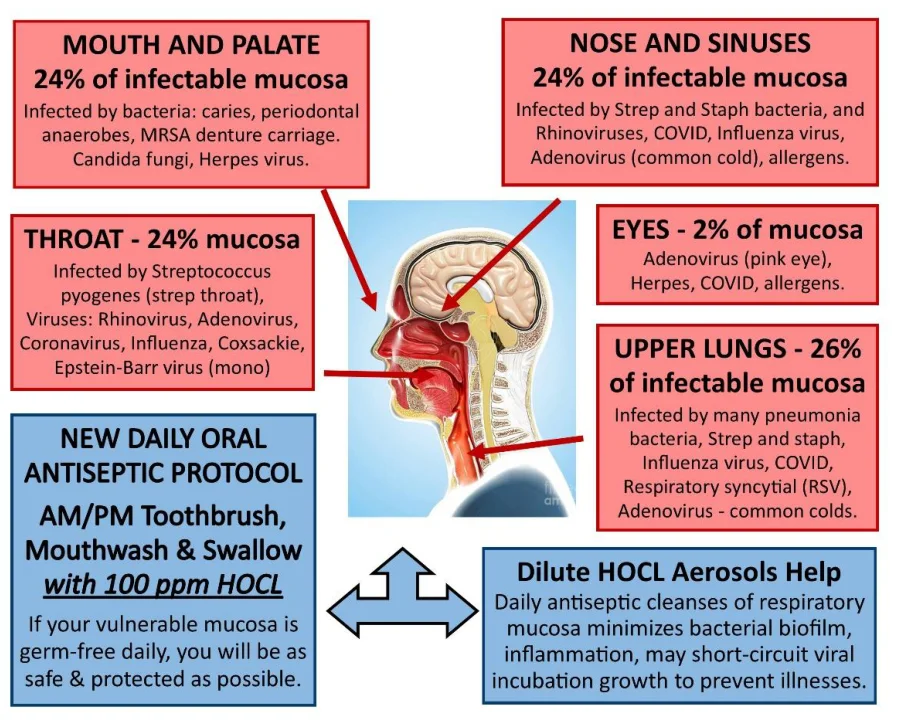
COVID is a viral hit-and run specialist that strikes at will and escapes Scot free. COVID easily infects the highly susceptible mucosal epithelial cells of our nose, mouth, throat and upper lungs.
Using a silent infection and super-fast replication, COVID builds a massive clone army by the billions in just 2-3 days. Millions of viruses burst out of us before our immune system can even respond. COVID always wins, escaping by the billions, leaving behind destruction and a massive immune system cleanup job. Theirs is not a complex microbial invasion...
1. MUCOSA cells are no barrier to COVID.
In fact, the mucosal cell is COVID’s prime target host. COVID’s protein spikes firmly latch onto the ACE2 receptors of our mucosa. The locked-on virus injects its genetic material forcing the mucosal cell to replicate copies of the virus. Each raped cell breeds enemy viruses by the thousands.
2. COVID invades silently and replicates FAST!
With a gestation of 6 to 8 hours and 1000 viruses born per mucosal cell, viral numbers grow to billions in four or five generations. All it takes is 2 or 3 days of unprotected mucosa.
3. SYMPTOMS show up late.
You’re already sick. Contagiousness of viral shedding occurs before your immune system reacts. Viruses took over your entire mucosal landscape and escaped
before you knew it. The symptoms and sickness you experience is your immune system reacting violently and belatedly to the lost battle.
- COVID and countless bacteria easily infect our mucosa without a fight . We leave ourselves wide open to infection, which ignites our tired immune system yet again. This passivity must stop. It’s time to defend ourselves.
How does one speck of microscopic virus infect us so severely? How do we stop it?
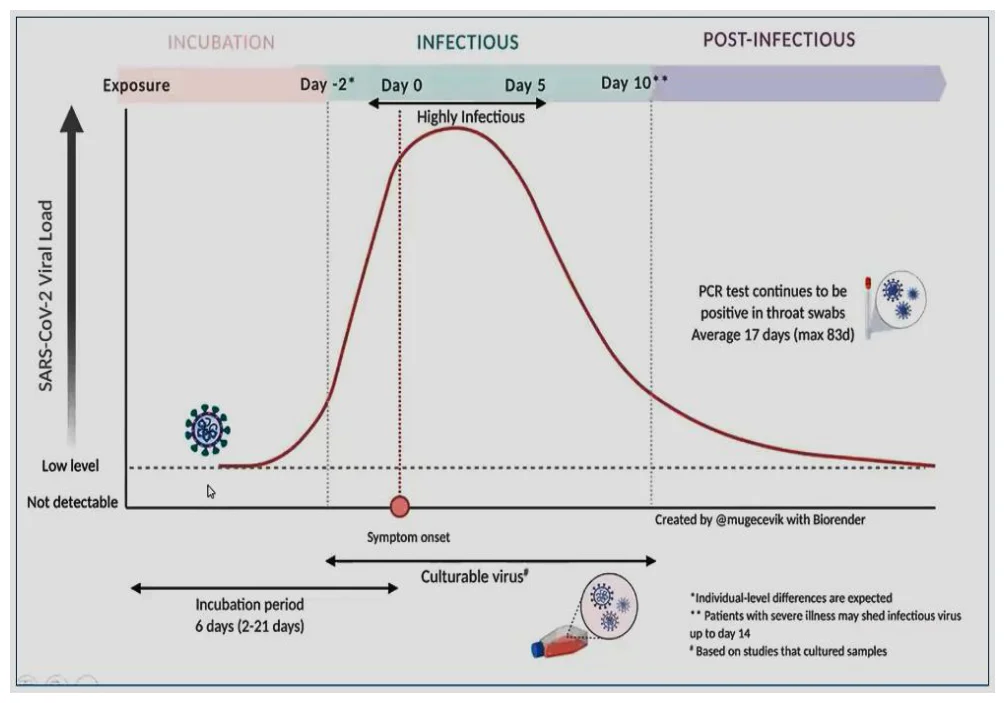
SARS-CoV-2 multiplies silently in the upper airway for several days before symptoms, then peaks around the time symptoms begin, and only later does the inflammatory “storm” drive severe and critical disease. That hidden incubation window—when viral load is rising but you still feel well—is the only realistic time to keep the virus from gaining a permanent foothold, which is exactly when daily mucosal hygiene can matter most.
The three phases are: pre-infectious Incubation, Infectious, and Post-infectious recovery
Approach, Attachment, Incubation: silent viral buildup
After the speck of virus first lands on nose, mouth, or throat mucosa, it enters epithelial cells and begins copying its genome, but there are no symptoms for about 3–5 days on average. During this presymptomatic phase, viral load in the upper respiratory tract climbs rapidly and typically reaches its peak around the day symptoms start or even 1–3 days before, meaning people are highly infectious while they still feel “normal.”
Because replication is concentrated on outermost mucosal surfaces early on, before the infection has spread deeply into lung tissue, that is the most accessible stage for chemical disruption by local antiseptics in the mouth and throat. Interrupting this expansion phase—by repeatedly reducing the number of virus particles on those surfaces—reduces the chance that enough infected cells accumulate to trigger full-blown illness.
Too Late! Symptomatic and inflammatory phases
Once the virus has replicated unchecked for several days, it spills into lower airways and sometimes the bloodstream, and symptoms such as fever, cough, and fatigue mark the transition into mild-to-moderate illness as mucosal viral loads remain high but begin a slow decline. In a subset of patients, especially with high initial viral loads, the host immune response becomes dysregulated about a week after symptom onset, leading to shortness of breath, hospitalisation, and in the worst cases ARDS and critical illness driven more by runaway inflammation than by new viral replication.
At this later stage, antiviral mouth or throat measures can no longer erase what has already happened systemically, because deep lung tissue and immune cascades are now the main drivers of disease. That is why the practical window for meaningful defense is the incubation and very early symptomatic period, when the virus is still largely confined to the accessible mucosa lining the oral and nasal passages.
Elder Dentist says: Disinfect your mouth daily to never get COVID again, God willing.
The body’s only real chance to stop COVID is while the virus is quietly multiplying on the surface of the mouth and throat, before symptoms and before the inflammatory storm begins. Daily, disciplined mucosal hygiene at that stage—Elder Dentist translation: brush and rinse the entire oral corridor with Searbicide HOCl morning and night—logically aims to keep viral numbers too low to ever reach “take-off” strength.
How to COVID-Proof your mouth and throat!
How do we fight back? What are COVID’s vulnerabilities?
1. We know where viral COVID strikes: our mucosa.
Mouth, nose, throat, lungs; our mucosa is the breeding grounds and therefore, our battlefield. All one billion mucosal epithelial cells in our oral corridor are at risk of viral infection. An internal area the size of an 8 ½ x 11 inch sheet of paper is where the battle is won or lost. The good news: All of it is accessible to an antiseptic to cleanse our ourselves of all germs. Simply say Ah!
2. COVID’s weakness: it needs a full DAY OR TWO of uncleansed mucosa to breed.
Viruses need 24-48 hours of uninterrupted time to infect all of our mucous membrane cells and reproduce billions of microbial monsters.
3. Our ideal weapon vs COVID is 100 ppm HOCL to use as an oral antiseptic mouthwash.
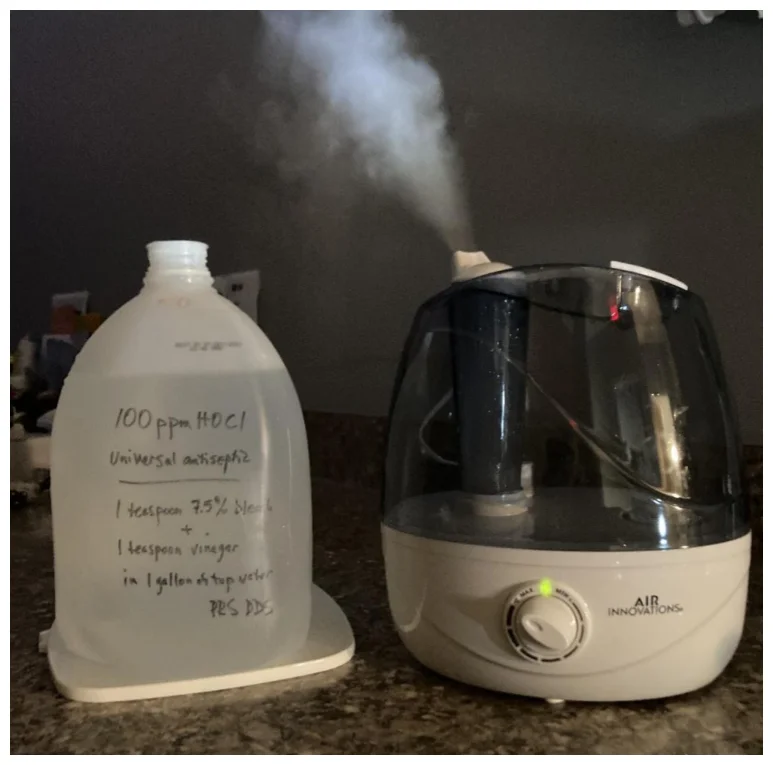
You can make an unlimited supply of homemade chlorine water at home which is a 100% safe and effective antiseptic for all mucosal membranes. 15 seconds sterilizes all germs, bacteria, and viruses. Amazing.
4. Daily mucosal hygiene will effectively prevent every COVID or bacterial infection.
In theory, if we protect all or even a majority of our vulnerable mucosal cells, any viral infection cannot achieve take-off numbers. We won’t get sick ever!
5. Rinse your mouth and throat with HOCL antiseptic once or twice a day
will logically and scientifically prevent all mucosal-based infections. HOCl aerosols are easily made to cleanse nose and lungs for anyone who wants or needs extra protection due to age or weakened immune status.
Defend yourself. Good health is earned with hygiene. Nobody is coming to your aid. Dentists and doctors need us to keep getting sick. HOCl is a free gift from God. Please use it.
Pre‑Symptom Mucosal Hygiene Protocol and Rationale for COVID and Flu (Prevention Phase)
Respiratory viruses such as SARS‑CoV‑2 follow a consistent pathogenesis sequence on the mucosa: they adhere to epithelial cells, penetrate, replicate intracellularly, and then spread laterally and outward, long before host symptoms appear. The decisive window is the first 24–48 hours, when virions are multiplying silently across the oro‑nasal and pharyngeal surfaces on a small, anatomically accessible sheet of mucosa roughly the size of a sheet of paper. During this time, the innate immune “war response” has not yet fully mobilized; viral kinetics are in control.
The goal of preventive mucosal hygiene is to interrupt this sequence at the surface—at the “adhere” and “spread” stages—by using HOCl as an external extension of innate chlorine chemistry to remove or inactivate virions before they complete multiple replication cycles. Properly made 100 ppm HOCl (from one gallon water + one teaspoon 7.5% bleach + one teaspoon vinegar, pH ≈ 6) behaves as dilute “chlorine water” that rapidly denatures exposed viral and microbial proteins while remaining gentle to epithelium.
Pre-symptom Protocol: Daily HOCl Swish‑and‑Swallow, Optional Nasal/Airway Mist
- Solution o 100 ppm HOCl (“chlorine water”) prepared as above, used fresh or within a few days
for routine preventive use.
- Frequency o Twice daily (every 12 hours): morning and evening, analogous to toothbrushing.
- Oral/oropharyngeal application o Take a mouthful of 100 ppm HOCl. o Sip, swish, and gargle to contact teeth, tongue, cheeks, soft palate, and posterior
pharynx for ~15 seconds. o Swallow to bathe the oropharynx; repeat once if desired.
- High‑risk extension (optional) o For older adults, immunocompromised patients, or those at higher risk of respiratory
complications, extend coverage to nasal and upper airway mucosa: o Use a nasal or oral spray or an ultrasonic humidifier filled with 100 ppm HOCl. o Perform several deep inhalations (e.g., a dozen breaths) to wet the nasopharynx and
upper airway during the same AM/PM sessions. Rationale
- Pathogenesis timing o SARS‑CoV‑2 must adhere to mucosal cells, penetrate, and complete several 6–8 hour
intracellular replication cycles to reach the high titers associated with disease and transmission. o This geometric expansion—adhere, penetrate, replicate, spread—occurs before
symptoms, during a silent incubation phase that typically spans the first 1–3 days.
- Strategic leverage o The battlefield is small (about one billion epithelial cells on an 8½ × 11 inch area),
and all of it is reachable from the outside. o Twice‑daily HOCl sweeps prevent the virus from enjoying an uninterrupted 24‑hour
window on a fully susceptible surface, repeatedly resetting surface viral load toward zero.
- Mechanism of benefit o HOCl targets sulfur‑containing and disulfide‑stabilized viral proteins (e.g., spike
adhesins), deforming their binding sites and neutralizing virions in seconds. o By lowering the number of successful adhesion events and the pool of free virions,
the protocol blunts exponential growth and reduces the probability that the infection can ever reach symptomatic, high‑titer levels.
In practical terms, this is “mouth‑and‑airway handwashing”: a twice‑daily, low‑cost, low‑risk procedure that keeps the primary entry mucosa too clean, too often, for most respiratory viruses to complete their early replication race.
When daily HOCl “mouth-and-airway handwashing” is in place before exposure, many infections may never gain a foothold. But life is messy, and sometimes the virus wins the first round despite our best routines.
When symptoms announce that replication is already underway, the strategy does not change in principle—it simply intensifies, matching HOCl contact to the new speed and scale of viral shedding.
Post‑Symptom Mucosal Hygiene Protocol for COVID and Flu (Therapeutic Phase)
Once symptoms appear or a significant exposure is strongly suspected, the infection has already progressed through multiple rounds of adhesion, penetration, replication, and spread on the mucosa. Infected epithelial cells are now continuously budding virions into airway secretions, reseeding the surface every few minutes. In this phase, the immune war machine is finally fully engaged, but it is working against a large, dynamic viral burden on a still‑accessible surface.
The therapeutic mucosal hygiene protocol aims to match that dynamic: instead of twice‑daily cleansing, high‑frequency HOCl applications keep surface viral titers suppressed between budding cycles, limiting further spread, lowering total infectious load, and reducing the risk of severe systemic inflammation.
Post-Symptom Protocol: High‑Intensity HOCl Swish‑and‑Swallow ± Mist (First 12–24 hours)
- Solution
o 100 ppm HOCl for most therapeutic use; 100–200 ppm may be considered for
short‑term, intensive inhalation in robust adults, using distilled water for long‑term airway use.
- Oral/oropharyngeal application o Begin as soon as possible after first symptoms (sore throat, cough, fever, malaise) or
after a clear high‑risk exposure (e.g., prolonged close contact with an infected person). o Every 15–30 minutes during waking hours, take a mouthful of 100 ppm HOCl. o Sip, swish, gargle, and swallow to bathe the entire oropharynx; each application takes
~15 seconds. o Continue this schedule aggressively for at least the first 12 hours, then taper to hourly
or q2–3h as symptoms and energy allow, eventually returning to the preventive twice‑daily regimen.
- Nasal/upper airway extension o Use an ultrasonic humidifier or mesh nebulizer with 100–200 ppm HOCl for upper
airway and lung targeting. o Sit upright and perform 2–5 minutes of deep nasal and oral breathing of HOCl mist
every 30–60 minutes during the initial intensive phase, especially if cough or dyspnea is present.
- Prolonged contact options o Prepare ice chips from the same HOCl solution and allow them to melt slowly in the
mouth to extend contact with inflamed pharyngeal mucosa and add comfort.
Rationale
- Kinetic match o HOCl sterilizes the mucosal surface on contact but does not enter or reverse infection
inside cells; newly budded virions reappear on the surface within 15–30 minutes. o Only frequent re‑application maintains a persistently low surface viral load,
analogous to repeated wound irrigation to prevent a contaminated wound from becoming established.
- Containment and load reduction o By repeatedly disrupting the “spread” step at the surface, the protocol reduces the
chance that infection will advance deeply into the lungs and decreases the viral burden driving systemic immune activation. o Aerosolized HOCl extends this containment into the upper airway and proximal
lungs, where much of the progression from upper to lower respiratory disease occurs, and does so with extremely low toxicity at 100 ppm.
- Immune system support o Lowering mucosal viral titer and clearing proteinaceous debris reduces PAMP and
DAMP signaling from the airway, easing the cytokine load that an older, inflammaging immune system must bear. o The immune response can then operate more as a controlled cleanup and repair effort
and less as an overwhelming, self‑injuring storm.
Used this way, HOCl‑based mucosal hygiene does not replace immunity; it changes the terrain. It keeps the battle confined to a repeatedly cleansed, accessible surface where viral pathogenesis can be interrupted and the immune war can be shorter, smaller, and less destructive.