How HOCl and NCT Target Virulence Proteins and Cytokines
Chapter 18 showed the problem: cytokines are essential signals, but when they stay elevated too long, the immune system stops resolving and starts injuring the host. The next question is obvious: if chronic inflammation is partly a failure of chemistry, what kind of chemistry can help restore balance without simply shutting immunity down?
That is where chlorine becomes interesting. HOCl is not a blunt chemical weapon spraying indiscriminate damage; it is a highly reactive, biologically tuned oxidant with a marked preference for sulfur-rich and structurally exposed protein targets. In other words, it does not act like a firestorm. It acts more like a selective chemical strike against the protein features pathogens depend on most.
This distinction matters because it changes the whole way we think about chlorine in biology. If chlorine were merely destructive, it would be hard to reconcile with innate immunity. But if it is selective — especially toward cysteine, methionine, and other vulnerable protein structures — then its behavior begins to make sense as part of the body’s own defense architecture.
That selectivity also helps explain why N-chlorotaurine, or NCT, deserves attention after Chapter 18. NCT is the gentler downstream chlorine species that may help move the system from attack toward resolution. And in obese mice with LPS-induced pneumonia, it already has an in vivo proof-of-principle study showing reduced lung edema, lower IL-6 and TNF-α, and less muscle wasting.
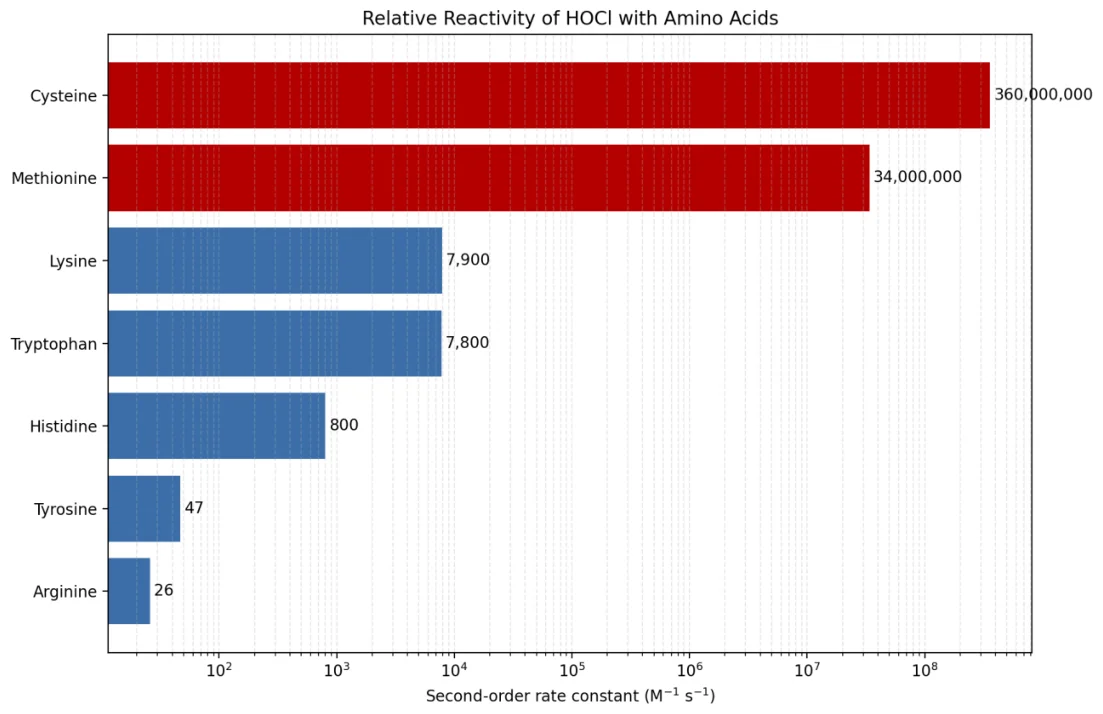
Chlorine hits the sulfur target 9999 times out of 10,000
The most important chemical theme is chlorine’s affinity for sulfur. HOCl reacts rapidly with cysteine and methionine 10,000 times more rapidly than other amino acids, and those sulfur-containing residues are often central to protein folding, binding, and enzymatic activity.
Ref. A. Ulfig,· “The effects of neutrophil‑generated hypochlorous acid and other hypohalous acids on host and pathogens”, Cellular and Molecular Life Sciences (2021) 78:385–414,
When a microbial virulence protein depends on exposed sulfur chemistry or on disulfide bonds to maintain its functional shape, HOCl can disrupt that structure very efficiently. That is why the antimicrobial action of HOCl is so powerful: it does not merely irritate microbes, it disables the protein machinery they need to invade, evade, and persist.
This also helps explain why chlorine can look nonspecific from a distance yet still behave selectively in real biological systems. The proteins most likely to be hit are the ones with the most accessible and most reactive sulfur chemistry. In other words, the biochemistry is broad in principle but selective in practice.
Virulence proteins are eliminated first
Pathogens are filled with chemically exposed structures that are good targets for HOCl. Their surface proteins, secreted enzymes, adhesins, and toxins often depend on precise conformations that can be disrupted by oxidation, chlorination, or disulfide damage. The review emphasizes that protein unfolding and aggregation are major mechanisms of HOCl-mediated killing, because once the pathogen’s proteins lose function, the organism loses viability. This is not random destruction; it is selective sabotage of microbial protein architecture.
That matters for the argument in this manuscript because it shows why chlorine is compatible with innate immunity. Neutrophils are not spraying indiscriminate poison. They are deploying a short-range oxidant designed to strike the most vulnerable proteins in the invader while remaining localized enough to reduce systemic exposure. That is the antimicrobial side of the story.
Host cytokines are targeted selectively in same fashion
The inflammatory side of the story is more subtle. HOCl can modify host proteins too, especially abundant plasma proteins and proteins exposed in inflamed tissue. Some of those modifications produce advanced oxidation protein products, which are associated with chronic inflammation and can themselves alter immune behavior. But the review also notes that HOCl- modified host proteins can acquire chaperone-like properties and affect immune cell activation, which means protein chlorination can sometimes regulate inflammation rather than merely worsen it.
This is the point where NCT becomes especially interesting. NCT is the milder chloramine formed from taurine and excess HOCl, and it has repeatedly been associated with suppression of proinflammatory cytokines such as IL-1, IL-6, and TNF-α, as well as inhibition of NF-κB and related pathways. If HOCl is the sharp surgical strike, NCT may be the cleaner, gentler adjustment that preferentially engages the most exposed inflammatory protein signals without causing the broader damage of a stronger oxidant.
Chlorine’s selectivity and the shutdown problem
Taken together, the sulfur preference, the structural vulnerability of virulence proteins, and the emerging data on host protein chlorination point in the same direction: chlorine is not a random wrecking ball, it is a targeted way of rewriting protein function. At high, unbuffered doses that chemistry can be brutal, but in the tight, localized microenvironments where neutrophils work, it is more like a series of selective strikes against the most reactive, most exposed parts of microbial and host proteins.
That picture helps resolve the apparent paradox of chlorine biology. The same oxidant that can sterilize a wound dressing can also be produced inside a living neutrophil without instantly destroying the cell and its neighbors. The key is not just how much chlorine is present, but what form it takes, which targets are hit first, and how quickly the system can convert sharp, short-range chemistry into something milder and more diffusive once the immediate danger has passed.
Why a downstream chlorine carrier is needed The immune system cannot live on HOCl alone. HOCl is made for close-quarters combat: fast, reactive, and short-lived, ideal for dismantling disulfide-locked virulence proteins and denaturing microbial enzymes at contact range. That same speed makes it a poor candidate for carrying information about danger or resolution into surrounding tissues, because by the time HOCl diffuses very far from the phagolysosome or neutrophil extracellular trap, it has already reacted.
A shutdown script, however, needs a slower, gentler carrier. Once the main microbial targets have been hit, the chemistry must change from “cutting wires” to “quieting signals” so that macrophages can shift from M1 to M2 behavior, neutrophils can stand down, and tissues can move from defense back to repair. The biochemistry summarized in this chapter suggests that the body solves that problem not by abandoning chlorine, but by transforming it into downstream species that retain selectivity while giving up some of HOCl’s raw aggression.
N-chlorotaurine as the likely relay to Resolution
N-chlorotaurine (NCT) is the most plausible candidate for that downstream role. HOCl’s strong preference for sulfur and related reactive sites means it rapidly reacts with taurine, a sulfur-containing amino acid that is abundant in neutrophils, monocytes, and extracellular fluids. The result is a longer-lived chloramine that still carries active chlorine but reacts more slowly, diffuses farther, and is markedly better tolerated by host tissues than HOCl itself under repeated exposure.
Seen in this light, HOCl and NCT function less like separate chemicals and more like a relay. HOCl delivers the initial, sulfur-focused strike against virulence proteins and vulnerable microbial structures. NCT then carries the chlorine “message” outward in a form that can still touch exposed microbial and host proteins, but with kinetics and selectivity that are better suited to shaping cytokine tone, macrophage programming, and tissue repair instead of simply killing everything nearby.
Where the story goes next
This chapter has stayed with the chemistry: why chlorine prefers sulfur, how that selectivity dismantles virulence machinery first, and how host protein chlorination can, in some contexts, regulate inflammatory signaling instead of merely adding to the damage. The next chapter takes the natural step from chemistry to physiology by asking what N-chlorotaurine actually does in living systems when the urgent task is not the initial kill but the safe return to homeostasis.
Chapter 20 will examine NCT as a possible immunomodulator and resolution aid. It will look at how a slower, gentler chlorine carrier might help quiet excessive cytokine signaling, preserve immune competence, and protect vulnerable tissues in settings ranging from infected lungs to metabolically inflamed, obesity-primed hosts, while staying within the honest limits of current animal and early clinical data.