Household bleach and Searbicide are members of the same chlorine family, but they live in different chemical worlds. Bleach is a high‑pH lye solution with dormant chlorine riding along. Searbicide is low‑pH hypochlorous acid HOCl, the same molecule neutrophils use to kill germs. Chemically, they barely overlap. Medically, they should never have been lumped together.
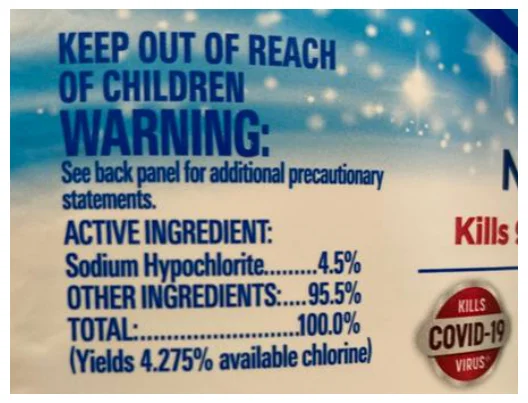
For 150 years, industry and regulators defined bleach by its “available chlorine,” not by the rest of what is in the bottle. Sodium hypochlorite NaOCl went on the label as the “active ingredient.” Sodium hydroxide NaOH, the lye that actually burns skin and dissolves fabric, went into the “other ingredients” bucket. The result was an innocent but costly confusion. Bleach was treated as a single substance called hypochlorite, and all its good and bad effects were blamed on that one name.
Once you separate the chemistry into its parts, the story changes. You discover that the same industrial process that gives us bleach also gives us a medical tool our immune system already uses. That tool is HOCl at the right pH and concentration. Under the name Searbicide, it becomes the capstone of two centuries of infection‑control progress.
1. How bleach is really made: two powers in one bottle
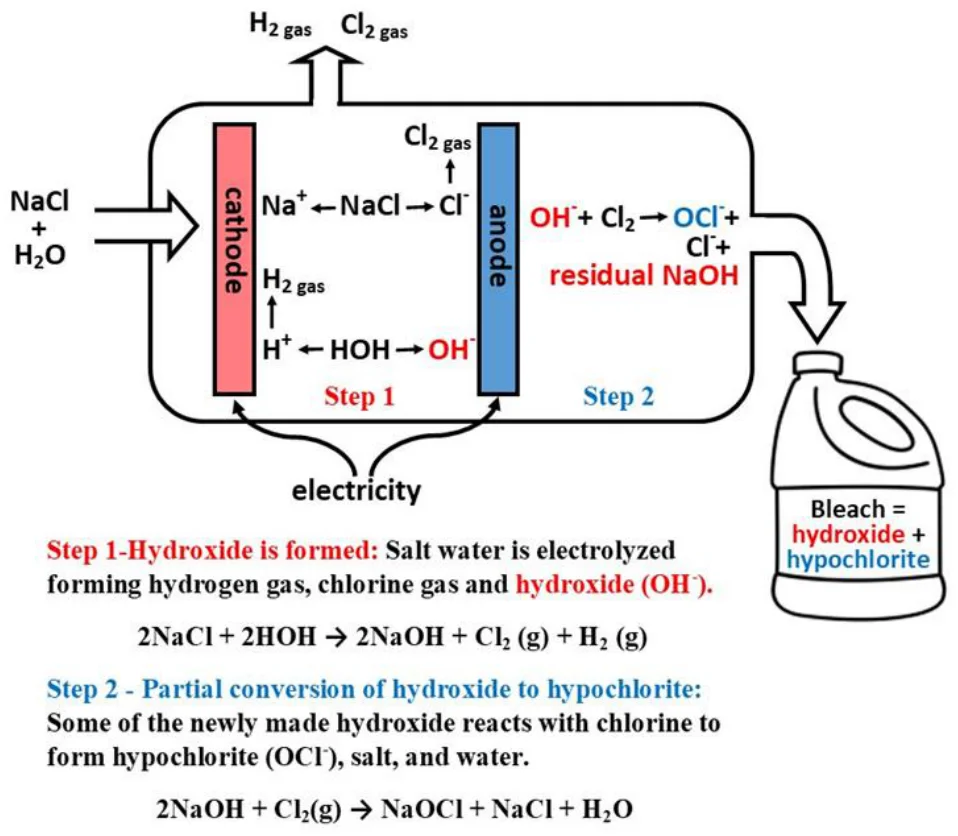
Bleach starts with a simple, brutal industrial process: chlor‑alkali electrolysis. Salt water is split by electricity into three products:
- Chlorine gas Cl2
- Hydrogen gas H2
- Sodium hydroxide NaOH (lye)
At this stage, you have what soap‑makers love and doctors fear: a tank of hot lye. It is extremely alkaline, saponifies fats, denatures proteins, and corrodes metals. On its own, it is a powerful dissolver, not a subtle disinfectant.
The second step adds chlorine gas back into part of that lye:
Cl2 + 2NaOH →NaOCl + NaCl + H2O
Now you have sodium hypochlorite NaOCl dissolved in water, but industry deliberately leaves excess NaOH in the mix to stabilize it. The final bleach drum therefore contains:
- A large amount of sodium hydroxide NaOH/OH−
- A smaller amount of sodium hypochlorite NaOCl/OCl−
- Salt and water
One ingredient label, two very different chemistries:
- Hydroxide - the strong base that saponifies fats, breaks peptide bonds, and burns tissue.
- Hypochlorite - a chlorine carrier that only turns into biologically powerful HOCl when the pH is pushed down.
The first visual in this chapter says exactly that: electrolysis makes lye first, then part of the lye is converted to hypochlorite, and excess lye is left in the bottle. Bleach was never just “hypochlorite.” It has always been “hypochlorite in lye.”
2. The pH spectrum: why bleach and HOCl are opposites
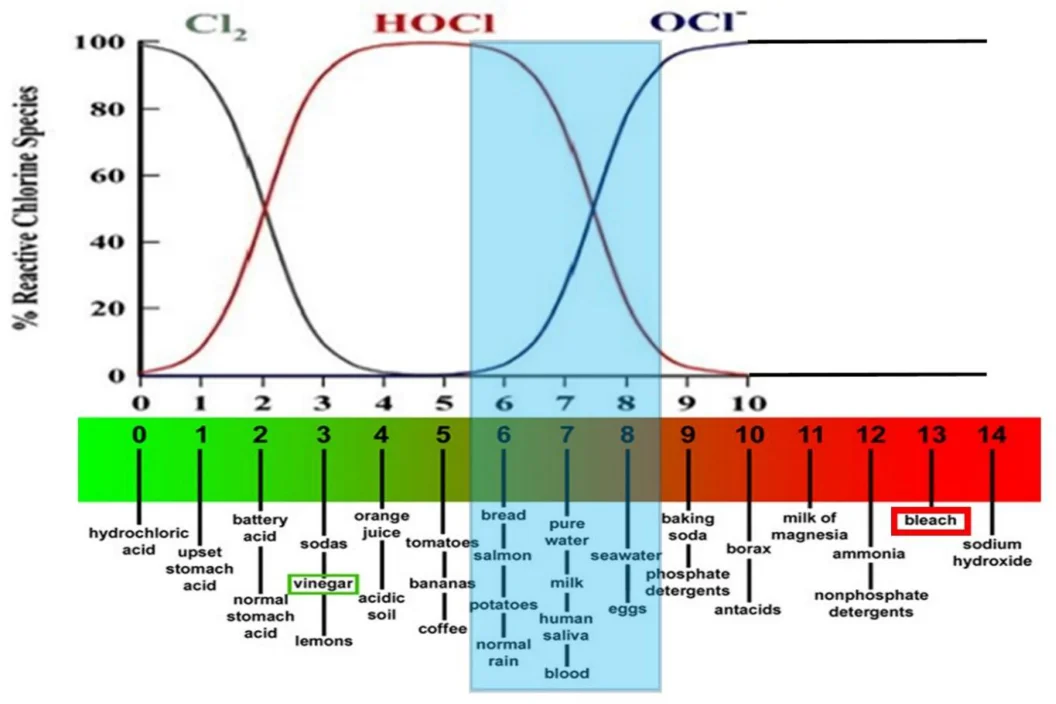
Chlorine in water is not one thing. It changes form with pH. That simple fact explains why bleach and Searbicide behave like opposites.
As pH changes, chlorine in water shifts between:
- Chlorine gas Cl2 (very acidic solutions, pH < 3)
- Hypochlorous acid HOCl (slightly acidic to neutral, pH ~ 4–7)
- Hypochlorite ion OCl− (alkaline solutions, pH > 7.5)
Rutala and others have pointed out that undissociated HOCl is the active microbicidal species. That is the form neutrophils make inside phagosomes. It is also the form that disappears when pH is too high.
At three key pH values, the speciation looks like this (for a fixed total chlorine, say 50 ppm):
- pH 6: about 97% HOCl, 3% OCl⁻. Hydroxide is essentially zero. The Searbicide zone.
- pH 7: about 76% HOCl, 24% OCl⁻.
- pH 8: about 24% HOCl, 76% OCl⁻, still little free hydroxide.
- pH 11–13 (bleach): almost all chlorine is OCl⁻, and the solution is loaded with hydroxide from NaOH. At pH ~12, bleach is a high‑pH hydroxide soup with dormant chlorine. At pH ~6, Searbicide is a low‑pH HOCl solution with no lye. They share a chlorine backbone, but their pH windows and behavior do not overlap.
3. Hydroxide dissolver vs HOCl scalpel
Once you see the pH spectrum, the next question is obvious: what do these species actually do to human tissue?
A simple chart answers that:
| Chemicals | Hypochlorous acid at biologic pHs | Hydroxide in bleach |
|---|---|---|
| Typical form | 50–100 ppm HOCl at pH ~6 (weakly acidic) | Bleach: 5–7.5% NaOCl with excess NaOH, pH 11–13 (strongly caustic) |
| Dominant species | HOCl (>95% of free chlorine at pH 5–6) | OH⁻ and OCl⁻ only, essentially no HOCl at pH ≥ 12 |
| Tissue effect | Mild oxidative nicking of exposed sulfur in proteins preserves our mucosal architecture at low ppm. | Saponifies lipids, breaks peptide bonds, denatures proteins; deep chemical burns and dissolution. |
| Immune analogy | Mirrors neutrophil HOCl in phagosomes and on NETs; helps clearance and resolution | No physiological counterpart; equivalent to a lye injury, not a controlled immune response |
Translated into plain language:
- Hydroxide is a bulk dissolver. It attacks the backbone of fats and proteins, turning structured tissue into a soup. In dentistry, that is why strong NaOCl dissolves necrotic pulp and biofilm in canals—and why it burns if extruded.
- HOCl is a targeted oxidant. At 50–100 ppm and pH ~6, it crosses membranes and preferentially attacks sulfur‑rich virulence proteins, disulfide bonds, and volatile sulfur compounds. It dismantles microbial tools and biofilm scaffolds without stripping mucosa.
Bleach works as a cleaner because it is lye‑strong. HOCl works as a mucosal antiseptic because it is immune‑like. The active pH ranges for these two roles do not overlap.
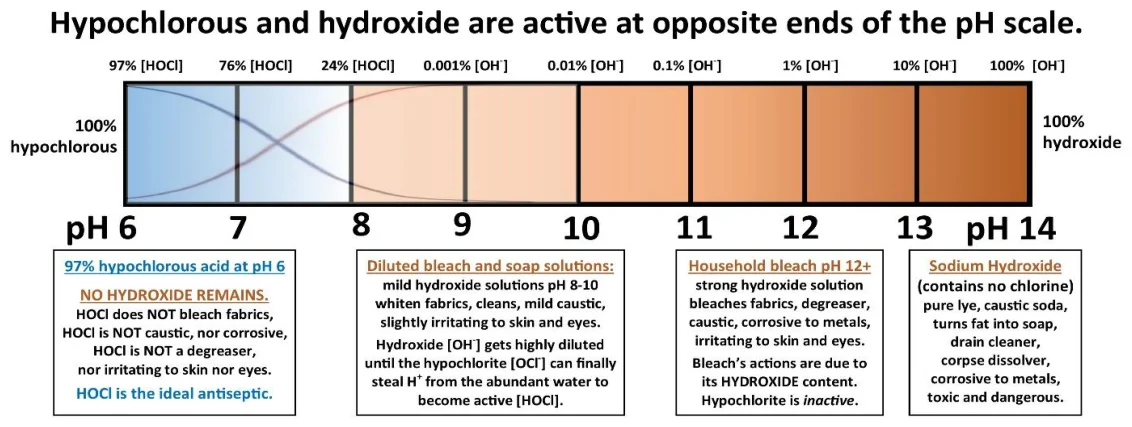
This is the “high‑school chemistry” level that medicine never clearly laid out. Once you see this chart, it becomes hard to justify treating all chlorine chemistry as if it were just bleach.
4. Searbicide: bleach‑derived, not bleach
If bleach is harmful to tissue because of its hydroxide and high pH, the obvious question is whether we can keep the HOCl biology and discard the lye. That is exactly what Searbicide does.
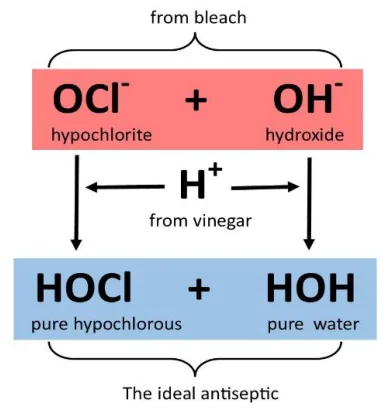
The starting point is dilute hypochlorite, which you can obtain from standard household bleach. In water, hypochlorite and hydroxide coexist at high pH:
NaOCl ⇌Na+ + OCl−
NaOH ⇌Na+ + OH−
Add a weak acid such as 5% vinegar, and two things happen at once:
OCl−+ H+ →HOCl
OH−+ H+ →H2O As pH drifts downward into the 5–6 range:
- Almost all active chlorine becomes HOCl.
- Hydroxide is neutralized into water.
- The remaining salts are physiologic.
Chemically, you have taken a hypochlorite‑in‑lye cleaner and turned it into a pure HOCl solution at the same concentration, with no free lye. That is Searbicide.
Ono’s work shows that a 50 ppm HOCl solution at pH 5–6 kills a broad spectrum of bacteria—including drug‑resistant ESKAPE strains—plus fungi and at least one virus within 15– 60 seconds at room temperature. Spores take minutes, but still succumb faster when HOCl dominates. The microbicidal effect tracks HOCl concentration, not total chlorine.
At body temperature and at inflamed sites, the same chemistry acts even faster. At 50–100 ppm, this solution is also well tolerated by skin and mucosa. It behaves like the immune system’s own HOCl, not like diluted drain cleaner.
The “bleach bottle to beaker labeled pH 6 HOCl” visual belongs here, with a caption as direct as the chemistry: “All the chlorine biology, none of the lye.”
5. How the name “bleach” misled infection control experts through history
With this chemistry in hand, you can revisit the history of infection control with a clearer lens.
From Berthollet’s eau de Javel to Labarraque’s hospital disinfectants and Tennant’s bleaching powder, chlorine solutions were prized as deodorizers and disinfectants for homes, factories, morgues, sewage, and water. They cleaned filth and stopped epidemics long before anyone understood neutrophils or HOCl.
Once “bleach” became an industrial commodity, it was defined and regulated as sodium hypochlorite, measured by available chlorine. The lye in the bottle was treated as a stabilizer and ignored. When hospital infection‑control experts like Rutala evaluated chlorine, they quite reasonably judged “hypochlorite solutions” as too irritating and corrosive for wounds and mucosa—because they were.
Nearly all the toxicity they saw belonged to hydroxide and high pH, not to HOCl itself. But because labels and regulations spoke only of hypochlorite, this nuance never made it into guidelines. Chlorine was banished from modern wound care and mucosal antisepsis as “too harsh,” while glutaraldehyde, peracetic acid, and other proprietary agents took over high‑level disinfection lists. Chlorine stayed on floors, laundry, but never endoscope reprocessors. (Rutala tilted that playing field away from chlorine to “new” high-level disinfectants the CDC Guidelines themselves. You can guess why…)
In parallel, dentistry quietly used both sides of bleach/chlorine chemistry without naming them that way. Concentrated NaOCl was embraced in endodontics for the pulp‑dissolving power of hydroxide and the germ-disinfecting power of HOCl when diluted.
More neutral but still very strong hypochlorite solutions like EUSOL were used on wounds as early attempts at safe HOCl territory (in the trenches of WWI no less).
Few modern researchers draw a clean line between “dissolver phase” (hydroxide) and “disinfectant phase” (HOCl). The naming mistake persisted: bleach = hypochlorite = chlorine = harsh. The immune system’s own HOCl was hiding behind a laundry product.